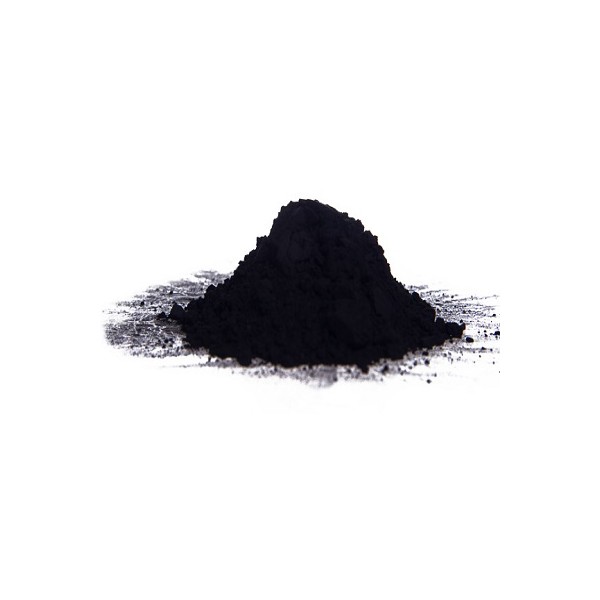
Vine black
This deep black pigment is not of organic origin, but a naturally occurring iron ore. It has a tendency towards blue-black, just like that of the blue sheen of the full, ripe grape. With its very strong opacity, it can be used in any type of plaster or paint.
Up to 350 g in a sturdy tin can, 1 kg in a paper bag.
We have not provided a data sheet for this product
This deep black pigment is not of organic origin but a naturally occurring iron ore. It tends towards a bluish black, just like the blue bloom on a full, ripe grape. With its very high opacity, it can be used in any kind of plaster or paint.
black pigment for grey paints
Building with natural building materials doesn't mean dreary grey – it's as colourful as life itself! Pigments are the material of choice for adding colour to walls, façades or timber components. Many pigments are earth pigments, distinguished by their specific shades. There are also inorganic pigments, which are produced from metals or minerals. Most of the raw materials for these come from Europe. They are ground in a pigment mill in France. The use of these pigments has a centuries-old tradition. They have proven themselves in a wide range of applications. On façades they are lightfast and water-resistant. As a dry powder, the pigments themselves contain no solvents. Please observe the information in the safety data sheet when mixing.
In addition to their use in lime, clay, casein and chalk paints, the pigments are suitable for tinting fine lime plasters, lime finishes, tadelakt and wall glaze binders such as sinter water or casein. Not all pigments are lime-fast; we will be happy to advise you on whether they are compatible with the material for your wall surface. You can even make coloured oil paints for wood surfaces with pigments. Whether you prefer pastel shades or bold colours: every nuance of a colour can be achieved; the mixing ratio determines the intensity. Up to ten per cent pigment can be added to most paints. If the recipe is followed exactly, all colour shades can be reproduced time and again. Only with the earth pigments are very slight variations possible, as they are naturally occurring earths.
For an even, streak-free surface, we recommend soaking the pigments in water the day before.
Handelsmarke Adresse
Le Moulin à CouleursHameau Bonne Fontaine, 08130 Ecordal, Frankreich
+33 3 24 71 22 75
moulincouleurs@wanadoo.fr