Floor insulation in older buildings
Impact sound insulation, as the term suggests, reduces noise pollution on the lower floors, caused by walking on the floor on the upper floor. This insulation can be achieved using various building materials and construction methods. It is fundamentally important that the floor is decoupled from the ceiling structure below.
Soft materials separate the floor of the room above from the heavy ceiling build-up, preventing sound transmission. Examples of such soft building materials are wood fibre boards topped with a final floorboard layer, or, particularly interesting in older buildings, hemp light clay.
Impact sound insulation with soft wood fibre
Spreading this loose-fill material over the surface is practicable even on warped and uneven ceilings in old buildings, as it compensates for irregularities in the simplest way and prepares a perfectly level substrate for the floor. The battens for the substructure of the floorboards are laid floating on this fill.
Because of the uniform thickness of the soft wood fiber boards, they in turn require an already existing, flat and straight floor structure.
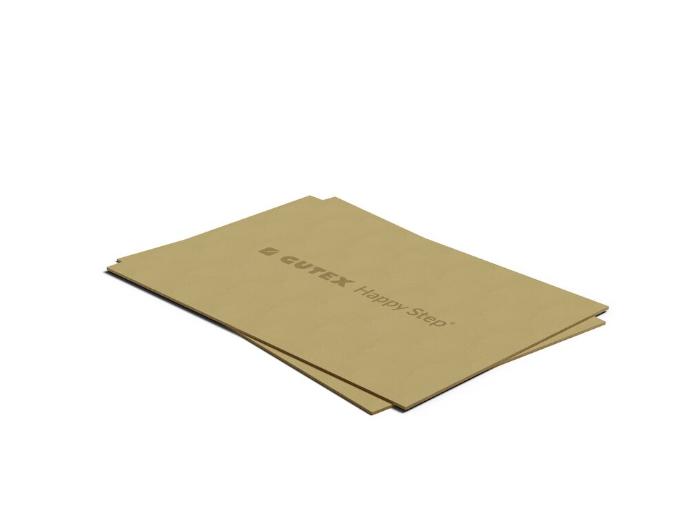

Floating floor construction
For a floor design with stoneware or tiles, you lay a pound instead of the planks and continue with the usual structure for this covering.
Impact sound insulation can only function properly if sound transmission is excluded: at the wall connections and in the entire ceiling-floor construction, the floor must be separated from the substrate and the walls. For this reason, counter-battens are laid floating instead of being fastened to the subsurface, either in the hemp-light clay or between the soft wood fiberboards. This creates a vibrating floor structure, the movements of which, however, do not continue in the ceiling below. So it is also important to insulate the flanks of the floor towards the walls. Edge insulation strips made of cardboard or needled hemp fleece are suitable for this.
Impact sound insulation underlays made from natural fibres
Under a plank floor or a simple parquet floor, the manufacturer often recommends the use of impact sound mats made of Styrofoam. This can be done better. If you want to provide a real wood floor with an impact sound fleece, you should rely on quality and high-quality raw materials. There are fleeces needled from hemp or from sheep's wool. Both are of very high quality and are worthwhile several times over. The indoor climate will thank you!
With us you will find the right fleece for building a floor from natural building materials.
