We are delighted! Our Economy for the Common Good balance sheet is complete! The Lehm-Laden has taken the demanding and exciting path to a full balance sheet and achieved an impressive 651 points. We have learned a lot about ourselves and seen everything we have already accomplished and which common-good-oriented projects we still have to tackle in the future. The points scale of the ECG balance sheet is an assessment system that helps companies and organisations to evaluate and quantify their social, environmental and democratic performance. The balance sheet makes it possible to express an organisation’s impact on the common good in figures and thus make it comparable. The assessment takes the form of a report by the company covering a total of 20 topic areas. This so-called ECG report is evaluated by auditors and converted into a points scale. This scale ranges from -3,600 to +1,000 points, with 0 serving as the neutral point. Plus points represent positive contributions to the common good, while minus points indicate negative impacts, so that the total score reflects an organisation’s commitment to the common good.
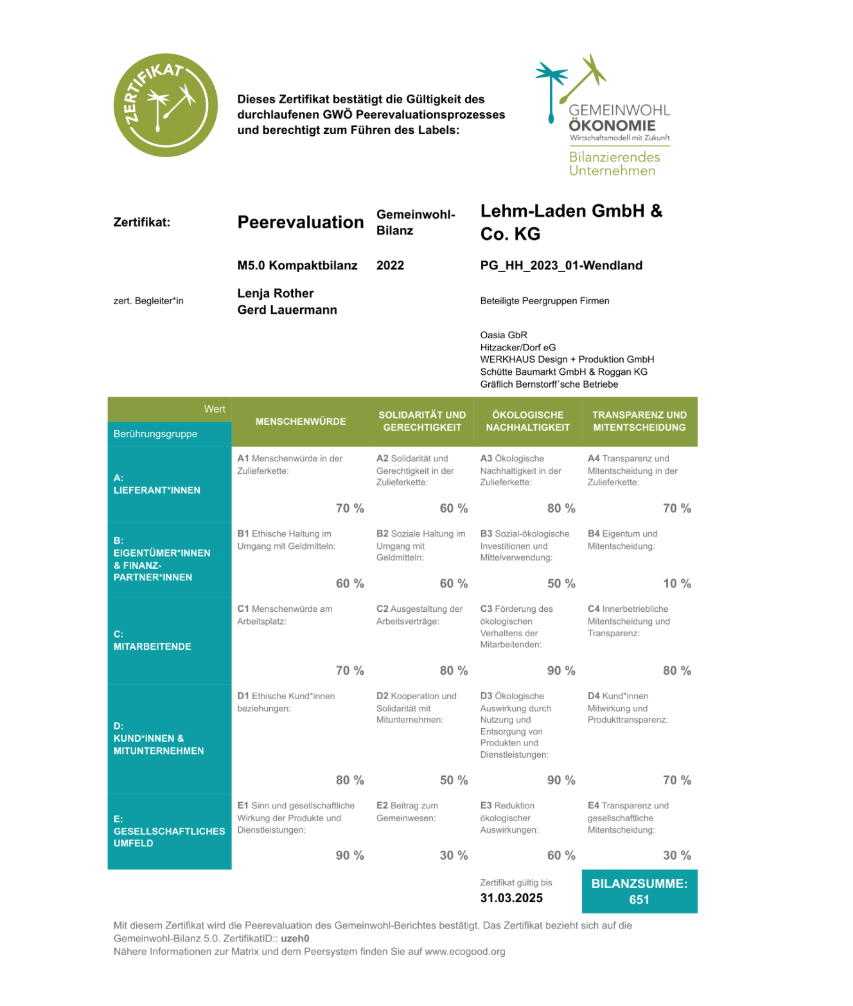
The assessment covers four different dimensions. The first dimension, human dignity, measures how fairly and respectfully the organisation treats its employees, customers, suppliers and other stakeholders. In addition, solidarity and justice within the company are examined: this measures an organisation's efforts to promote social justice and equal opportunities. The third dimension, building-biology aspects, deals with environmentally relevant aspects such as resource consumption, greenhouse gas emissions and the handling of natural resources. Finally, transparency and democracy assessed. This looks at the extent to which an organisation maintains transparent and democratic structures, discloses its decisions and enables stakeholders to have a say. Click here for our Economy for the Common Good (ECG) report:


Why did we have a Common Good balance sheet drawn up? There are several reasons why we joined the Economy for the Common Good (ECG) movement. It goes without saying that we have always shared this goal. However, as the company has grown and our mail-order business has expanded, new questions (including questions of purpose) have arisen: How meaningful is this new scale? Is what we are doing still good and right? How much growth is reasonable? Or how can growth be shaped in a sound way? How do we maintain our pioneering position fairly and resiliently in the growing online market for natural building materials? What challenges do rising transport costs and longer transport routes bring? How can “open management” be put into practice? Can we continue to pay everyone the same wage? What does transparent and fair pay look like in a steadily growing team?
Common good: We don't just want to be a successful company; we want to actively help ensure that our society benefits from what we do. Because we have taken our social responsibility as a company seriously from the very beginning, the ECG balance sheet was a logical step for us. The ECG balance sheet serves not only as a tool for self-assessment, but also as a guide for socially just corporate management. It helps us to recognise our strengths and weaknesses and to take targeted measures to improve our commitment to the common good. The points scale used in the ECG balance sheet is therefore a valuable tool that helps us to put our social responsibility and our corporate goals into concrete terms. In addition, the Economy for the Common Good reminds us that we are not alone in this world. We want to promote cooperation and solidarity and to work towards ensuring that the needs of the community take precedence over individual interests. We are convinced by the vision of an ethical economy. The exploitation of people, animals and the environment for economic interests must stop. The profit-driven economy of recent decades has already caused irreparable damage, and it is our shared task to overcome it, above all in order to protect and preserve our planet.
Environmental responsibility: Natural building materials have always been particularly close to our hearts. We are aware that our planet's resources are finite. The Common Good balance sheet spurs us on to keep improving the way we act and to find alternatives. We want to be a role model for responsible business.
Valuing our employees: Our employees are the Lehm-Laden's most valuable asset. With the Common Good balance sheet, we ensure that their needs and well-being are valued just as highly as the company's goals. Because satisfied employees make for a strong and committed community.
Shaping the future together: The decision to draw up a Common Good Balance Sheet makes us part of a worldwide community of companies and organisations committed to a fairer economy. Together we can achieve more and drive positive change. We have the opportunity to play an active part in shaping a better future. We are committed to an economy that is not geared solely towards short-term profit, but enables long-term well-being for all.


Transparency and measurability: Common Good accounting focuses on openness and honesty. By setting out our actions and their impact transparently, we take responsibility for what we do and enable our customers to make informed decisions. We can also better measure and document our progress and successes in achieving the goals we have set ourselves. This spurs us on to improve continuously and to bring about ever more positive change.
In summary, our decision to adopt Common Good accounting is a commitment to an economic model that puts people and nature at its centre. We are proud to play our part and to shape a fairer future together with you.