D: Stefan, great to have you here!
S: My pleasure. Thanks for the invitation!
D: We've known each other for quite a while now – would you like to briefly introduce yourself to our readers?
S: Sure. I originally trained as a carpenter, then I studied civil engineering. During my studies I started getting into natural building materials and, among other things, worked for the clay builder Renata Wendt. During a stay abroad in Ecuador, Colombia and Venezuela I then learned how to build with bamboo. Back in Europe, I did my placement semester at LehmTon Erde, Martin Rauch's company in Austria, and wrote my diploma thesis on Martin's rammed earth house. After graduating I was also given the chance to take on the site management of Martin's house. After that I was in Bangladesh with Anna Heringer, where we built a school and residential houses together with students – that was a really wonderful time too. When I came back to Germany afterwards, I became self-employed and had lots of exciting rammed earth projects and clay building sites, including for the FNR and in Xanten. With our first child I then settled down, and my field of work changed once again. Now I mainly do energy consultancy and some building-biology construction consultancy as a freelance engineer.
D: As an energy consultant you must be getting lots of enquiries at the moment.
S: Yes, I've certainly noticed the energy crisis. Many people are thinking about saving energy through insulation or new heating systems.
D: Can you tell me a bit about your work – what does a typical working day look like for you?
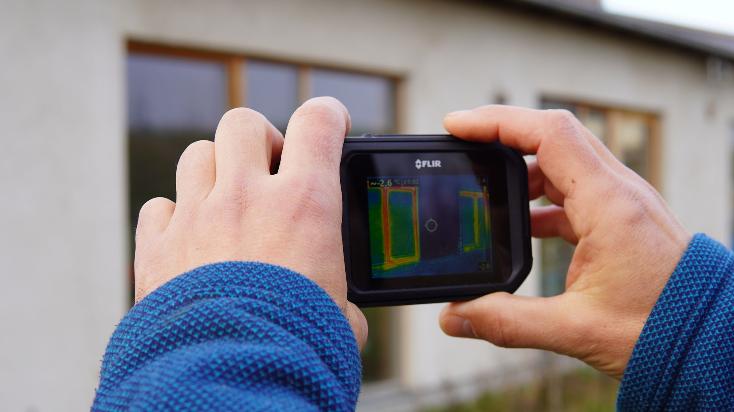
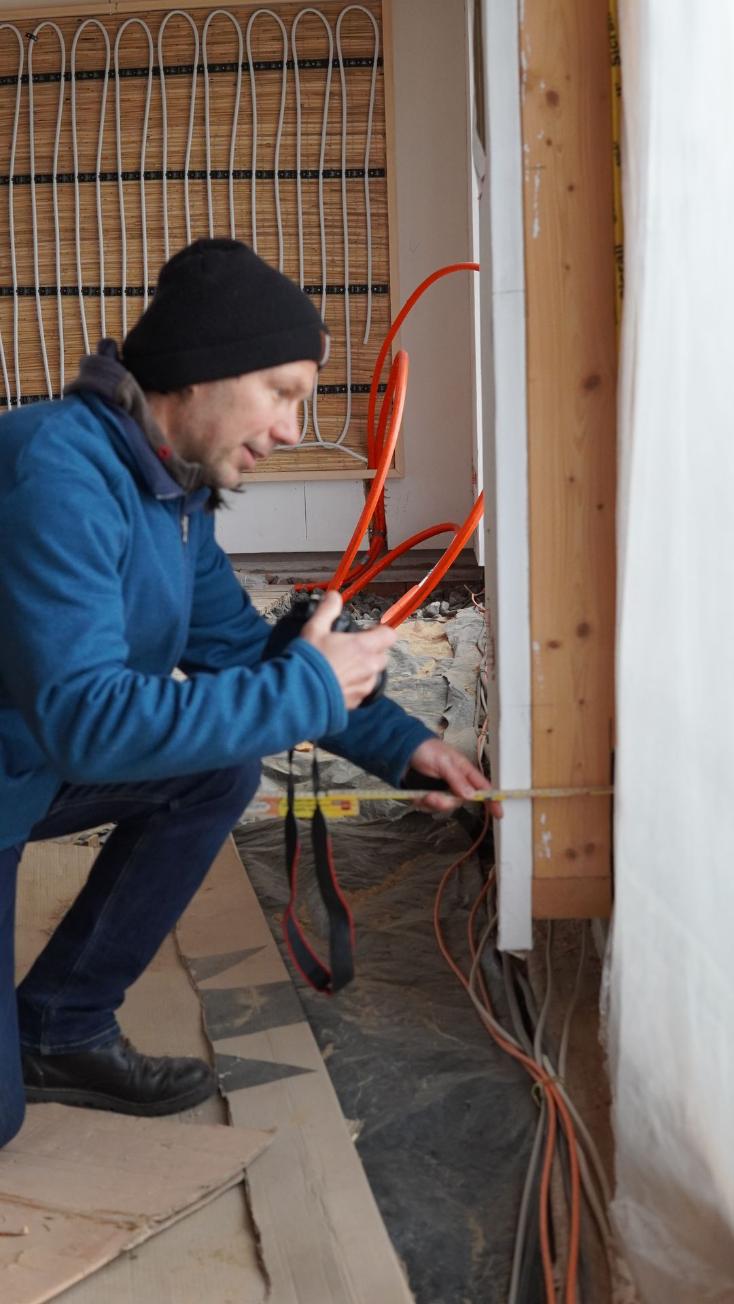
S: I spend a lot of time in my office, where I do all the calculations and documentation for the building sites. But I also go out to the sites, to record the existing condition before an energy consultation, or to check whether the build-ups I've calculated are actually being implemented.
D: Do you think quality assurance is really necessary? The energy consultant is already certified and approved, so the build-up has already been calculated correctly in advance.
S: Ultimately, construction supervision by an energy consultant isn't about assuring the quality of the tradesperson's work. That's what an architect does through site management. Construction supervision is only there to check that the insulation thicknesses or the standard required by the funding body – the one that qualifies for funding – are achieved. That's what gets checked. I don't check whether the windows have been installed correctly. I just look and say, OK, the windows that have been installed meet the standard that was applied for beforehand: so U-values, insulation standards and so on – but it's not about the quality of the workmanship.
D: So when you calculate an efficiency house, you define beforehand what insulation has to go in, and then you check afterwards whether it has been installed.
S: Exactly, that's right.
D: But up to now it has always been the case that the tradesperson has to submit a contractor's declaration stating that they did it in such and such a way.
S: Yes, but that's only in addition. As part of the construction supervision you do of course go out to the site now and then, take a photo and check whether the thermal conductivity value or the insulation thickness is printed on the insulation pack that's still lying around. The specialist contractor's declaration is there for the client's protection, but you don't have to submit it anywhere for the time being. The client just has to keep it safe so that they can provide proof in the event of an inspection. Ultimately it also protects the tradesperson, who can then say: look, this is what I installed! So it's all safeguarded on several levels.
D: And the energy consultant who is allowed to do this has already been approved beforehand. Not every energy consultant is allowed to do these calculations just like that.
S: Exactly, there are lists at BAFA and KfW. And if clients want funding, they have to choose someone from this list.
D: And are BAFA and KfW two different lists?
S: No, it's the same list. There always used to be two programmes. One was via BAFA and then there was also KfW. Now it's one programme, called the Federal Funding for Efficient Buildings (BEG). The two have been merged, but responsibilities are separate. Grants for individual measures (i.e. heating, building envelope such as windows, roof, walls) are all handled by BAFA. KfW now only provides loans for efficiency houses.
D: A list for two different institutions that subsidise different things, right?
S: Yes, exactly.
D: So these KfW standards that used to exist, KfW 55 or something like that, don't exist any more?
S: Oh yes, they still exist. KfW 40–KfW 85 are standards for an efficiency house. For existing buildings KfW 85, 70, 55, 40. For new builds only 40.
D: The higher the number, the worse.
S: Exactly.
D: And what does the number mean again?
S: Well, it's a bit complicated. Ultimately it's about primary energy. Alongside the building that's to be built, the Building Energy Act always defines a reference building with the same volume; the U-values of the building envelope and the building services are specified in the GEG. And I then have to relate the building I want to build, using the primary energy factor, as a percentage to this reference building. And the 40 then means that it may have 40% of the primary energy of the reference building, i.e. it has to be 60% better than the reference building specified by the GEG.
D: OK.
S: So the number doesn't refer to a consumption figure or anything like that, but always only to the ratio between the building to be built and a reference building.
D: And this reference building is, so to speak, the ultimate, the best of the best?
S. No, not at all. It corresponds to the average or the norm. The reference building is a kind of standard building.
D: Ah, so there's a reference building for all the different energy efficiency classes. The standard building has 100%, and then you have the different percentages by which you can improve. Accordingly, the lower the number, the better.
S: Yes, a 40 is 60% better than the reference building. An 85 only 15%.
D: OK.
S: You always have to look at two values: primary energy and transmission heat losses, where the transmission heat losses always relate to the building envelope, i.e. to the average of the U-values and to the entire building envelope. And primary energy actually relates more to the building services or the fuel used for heating, e.g. gas or biomass.
D: Ah, but not to the primary energy of the building materials.
S: No, building materials have nothing to do with it. Primary energy or “embodied energy” isn't taken into account at all. Not yet; sensibly, that's supposed to happen in future. But it isn't the case yet.
D: Isn't there a bonus or something for public buildings where the primary energy factor is decisive?
S: The primary energy factor depends on your energy source, i.e. electricity, coal, gas, wood.
D: So someone who heats their house with a heat pump and uses conventional electricity has a worse primary energy rating than someone who uses a renewable electricity tariff.
S: No, electricity is defined, so electricity is actually always the same. Your electricity supplier isn't taken into account. Electricity is then your “heating fuel”; you run your heat pump on electricity, so it says 1.8 as the primary energy factor.
D: And is that good?
S: Well, it could be better. 1.1 for wood pellets, I think. So biomass, photovoltaics and solar are better. But until a few years ago electricity was rated significantly worse. Because of the increasing share of renewable energy in electricity generation, the factor has been lowered. That's of course also one of the reasons why heat pumps are so popular now, because they perform quite well in the calculations.
D: So the electricity mix in Germany is partly responsible for heat pumps booming right now. Interesting.
S: It's a complex situation now: gas prices have also risen so much because of the war in Ukraine. That has of course made heat pumps even more competitive. Biomass is now more or less excluded politically, or at least rated significantly worse, with significantly less funding because of fine particulate emissions and because it's also finite in a certain way. And that's why a political decision has now been made to focus on electric heating. There's hardly anything else left. We want to move away from fossil fuels, so coal and gas are out. Biomass is no longer wanted either because of fine particulate emissions. That doesn't leave much: there's photovoltaics, solar thermal and of course the heat pump.
D: But heat pumps also have a big disadvantage – people often say – that they aren't sufficient in older buildings, especially in renovation. How do your clients deal with that? Everyone wants a heat pump at the moment, don't they?
S: Yes, because of course everyone hears that that's the solution. (laughs)
D: Don't you think it's the solution?
S: Well, you have to look closely at each building. You can't make a blanket statement that it works or it doesn't. Ultimately, heat pump manufacturers are of course developing extremely fast right now. A lot has happened in recent years. These days I'd say that if you manage to heat a building with a maximum flow temperature of 55 degrees, then it works.
D: Then it does.
S: Yes, I think heating is not really the problem. It's more about hot water, because of course you need significantly higher flow temperatures for hot water, and you have to find your own solution for that, because you may then have to switch to decentralised systems or reheating.
D: So that means with an instantaneous water heater, i.e. simply with electricity?
S: Yes, in summer a combination with PV is of course an obvious choice.
D: But then you also need a decent buffer store, so that you can really make use of the PV.
S: That again depends on the building and what kind of electricity demand I have. In a normal detached house it works, I think. You don't necessarily need a
storage system there. It always makes sense, of course, but the size is another question. Storage also costs a lot of money.
D: So you would rather look at storing the energy differently? Generating hot water during the day with electricity from PV?
S: No, you'd have to store that too. No, for decentralised hot water generation I wouldn't use a storage medium. I mean, hardly anyone showers at night. I think I'd rather change my usage behaviour. Shower when the sun is shining, or switch to solar thermal with storage. Going from PV to hot water, you lose a lot of energy in the conversion.
D: Sure, if the sun heats the water directly, that's definitely more efficient. I'd like to go back to natural insulation materials, and the fact that they aren't subsidised and that the actual insulation value of natural building materials is lower. That's really a big disadvantage. Nevertheless, I notice that they're booming and everyone wants them, simply because people know that they're good for the building, for people and for the environment. Is there any idea of when there will be subsidies for them? And why do people still choose them, rather than everyone using glass wool!?
S: Yes, there's certainly a change in awareness. Clients notice that with natural building materials they're doing something for the environment. Climate change doesn't come from nowhere; it comes from the fact that we waste an enormous amount of resources. Many more people have understood that by now. Natural building materials have the big advantage that they don't need so much energy to produce. Clients know that. Also, I think many people feel that it benefits their own wellbeing.
D: So it's only personal perception that's behind this boom. There are no financial incentives from politics, no subsidies, nothing at all for building with natural building materials. That really is a shortcoming.
S: Yes, well, the embodied energy that goes into building materials is supposed to be included in the assessment in the long term; how and at what point they'll do that, I don't know. But it's supposed to be taken into account. I know that in Austria, for example, there's a points system like that; we could do that here too. But of course we have a fairly large building materials lobby here that works against it. They naturally have an interest in continuing to sell their materials.
D: And in greenwashing.
S: Yes, I think ROCKWOOL also advertises that it sells natural building materials. (laughs)
D: Yes, I have nothing to do with that any more. A different world.
S: Yes, of course. People who want to install mineral wool don't come to you. I do come across it now and then. “Why don't we just use mineral wool?”
D: Do you find that hard?
S: Yes, I started out with the attitude that if people want to do that, then I won't do it. Now, of course, economic pressure has forced me to accept jobs that I otherwise wouldn't have taken on. Especially in the start-up phase I need almost every job. If I'm ever in a position where I can pick and choose, I'll leave those out. If someone then comes along who wants to insulate their roof with mineral wool, then no. They'll have to find someone else – there are plenty out there.
D: And do you have any way in an energy consultation of adding free text somewhere or making your own assessments, such as including longevity or embodied energy right now?
S: No, I consistently try to recommend to people, at least as far as insulation materials are concerned, that they use other materials – so no mineral wool! That automatically gets you talking. When it comes to the build-up thickness, e.g. in the roof, and the funding body specifies a U-value of 014W/m²K, you have to install a fair bit more insulation. And if I have a mineral wool with thermal conductivity group 032, I only need a build-up of 28 cm. If I work with 040 or 045 insulation, then I need 35. That can definitely be decisive, because it changes the whole construction and appearance.
D: On top of that there are of course economic reasons. More insulation costs more, and natural-fibre insulation materials are more expensive still.
S: Sure, mineral wool is cheaper and I need less of it. That hurts, but there's no way around it. Ultimately the customer decides.
D: Yes, and the better summer heat protection that a natural fibre offers isn't relevant for funding. So it isn't assessed…
S: Yes, unfortunately. If you were selling mineral wool on the shelf next to it and it was cheaper too, you'd have to convince people to buy the more expensive product, which also has poorer insulation values. You really have to go the extra mile and have good arguments.
D: Yes, well, particularly when it comes to roof insulation, I would argue that loose hemp fill offers by far the best summer heat protection. Because of climate change, cooling is becoming a big issue again. Heating in winter is always possible, cooling in summer is difficult. That's why summer heat protection through the right insulation material is extremely important. In theory, you could do a calculation or assessment of how expensive a building is to run. If you don't spend any energy on cooling, the extra cost of insulation made from natural raw materials would be recouped, wouldn't it?
S: It's certainly not that easy to show that in a calculation, and one difficulty you always have is that customers only have a certain amount of money available. Their budget is limited and naturally they want to do as much as possible.
D: Yes, future savings are just that – in the future.
S: Exactly. We think: better to invest a bit more now, you'll get more out of it. But even though that's true, unfortunately it's often not the deciding factor. Money is simply limited. If you have 150.000 available and can't or don't want to borrow more, then you have to see how best to use that money.
D: Are there professions that do this kind of economic calculation? Does an architect do that?
S: There's calculation software you can use to assess it. But it isn't part of any particular professional role. Not the architect's, not the energy consultant's. It's more of a specialist service.
D: Does anyone ever ask you for it?
S: No.
D: That surprises me. It's hugely relevant what a building costs over its life cycle. That's actually much more important than the initial investment.
S: I think very few people look that far ahead.
D: Yes, when I think back to when I bought this hall, I didn't think about what it would consume in energy costs either. Of course I saw that there were new windows here and old ones there. But I didn't work out what that would cost and when new windows would pay for themselves.
S: Yes, a cost-effectiveness calculation like that is difficult too. One person has to borrow money, interest rates are very volatile, the next person has the money tucked away and can invest it straight away. How will energy prices develop? Nobody knows that either.
D: Exactly, the volatility of energy prices.
S: Nobody would have expected what has happened over the last year. The energy prices that have risen as a result of the destructive war against Ukraine are of course having a positive effect on the climate. It's good that we're suddenly moving away from gas and coal, even if the reason is a sad one.
D: What I've noticed: until this energy crisis, or the rise in energy costs, we sold an awful lot of 60 Steico Internal insulation, because that was simply enough for most people. Now we mainly sell 80.
S: Yes, interesting. You know that curve – U-value in relation to insulation thickness. I always learned that 6cm gives the best ratio between insulation thickness and U-value improvement. At some point the extra 2 cm don't make much difference any more. Not much happens. But a lot happens in the first 6 cm. In terms of building physics I can always justify 6 cm, but at 8 cm I always start checking – wall heating yes or no, does it really work, timber-framed house... and I'm not sure about the cost-benefit.
D: Well, a lot of customers just come here without having had any advice beforehand. Then they see, oh, there's 80 as well. So they take 80, on the principle of “more is better”. I always say that the 60 board can be used in any building without complications. You can't do any damage with it. But with the 80 board you can do real damage, especially in a timber-framed house, if it's too exposed to the weather and not enough heat reaches it.
S: Yes, that's true.
D: A completely normal brick house with cavity walls. You can do less damage there in terms of building physics, can't you? Or can something happen there too if you put in too much internal insulation?
S: You obviously have to look at the overall construction to decide whether something works or not – so with regard to weathering you have to ask: is there a cavity? What water absorption capacity do the bricks have? What materials am I installing? What temperature and humidity are there in the rooms? You simply can't make a blanket statement. That would be too simple. Customers would like that, of course – but unfortunately it's not that simple.
D: But that's your job as an energy consultant, to calculate that specifically for a particular house, isn't it?
S: Yes, although of course I mainly make sure that energy costs go down. That's my actual job as an energy consultant. The other thing – whether a construction works or not – is really more the job of a specialist building physics engineer. There's definitely some overlap, but the perspective is completely different.
D: So a building physicist isn't automatically a good energy consultant, and vice versa.
S: Yes, I've just done an energy consultation for a listed building in Ratzeburg. The client was an architect and got back in touch after the energy consultation: he'd been thinking about it. There was a cavity after all, and maybe it could simply be filled with insulation. I said: “Well, I'd be careful there. Do you know anything about the masonry's protection against driving rain?” He said he assumed I knew all about that. But that's actually no longer an energy consultation. That's specialist building physics design. I have to check whether moisture protection is also ensured. Moisture protection is not the same as thermal protection. The question of the cavity comes up again and again, because at first glance it seems to be an obvious option (for relatively thin insulation), but many people overlook the fact that it doesn't always work and can, under certain circumstances, actually cause problems.
D: So as an energy consultant you also provide building physics advice?
S: I decide case by case. If I'm confident that I can calculate and assess it in good conscience, I'll take it on, but of course it costs extra. Energy consultancy is one thing, specialist building physics design is another.
D: OK, so that's your job as a civil engineer and no longer as an energy consultant.
S: Exactly. As an energy consultant I could say: “Brilliant, a cavity – we'll insulate that, then the house uses less energy and the customer has lower heating costs.” In theory, that would be the energy consultation done. But now building physics comes into play: is the external masonry (west side, 5 m high, no roof overhang) actually watertight? What about the joints?
Here's an example: driving rain hits the gable on the weather side, the pointing has all but disappeared, water penetrates and suddenly there are damp patches on the inside of the wall… The customer is annoyed and complains to the energy consultant: “Why didn't you tell us?” The energy consultant could then say: “Well, you wanted to know how to save on heating costs, but you didn't want to know how it works in terms of building physics. You didn't ask me that.”
D: Exactly. But that's also knowledge I first have to acquire as a client – knowing WHAT to ask WHOM.
S: That's true, but the enquiry came from an architect. I had assumed he knew the difference between an energy consultation and building physics advice.
D: That kind of advice is also where you separate the wheat from the chaff.
S: Exactly. Another classic case is flat roofs with greening: does it work or not? What about a moisture-variable vapour control layer? As an energy consultant I say: “Well, you need to achieve a U-value of 014W/m²K, so you need 30 cm of insulation.” And that's my energy consultation done. But if the build-up is such that it can't work in terms of building physics, because there's a waterproofing membrane on top and the vapour control layer isn't moisture-variable, then people are building structural damage into their house, because the energy consultant only advised on energy.
D: But you would always point it out if you saw that it was definitely going to go wrong, wouldn't you?
S: Yes, I'm involved too, after all. Sitting back and saying: “They only wanted to know how to save on energy costs” is of course a difficult stance to take!
D: Yes, that reminds me of our site on the Baltic coast, where we installed the hemp-lime blocks and then, during heavy driving rain, moisture simply came through to the inside.
S: But the insulating blocks hadn't been installed yet at that point; only the outer blocks were in. The problem was the junction with the timber frame. The gable and the weathering on the west side had never been an issue before, and neither had the joint between the infill and the timber framing, which you can never get 100% tight. There are of course ways of improving it, e.g. with pre-compressed sealing tape or a triangular fillet strip. But none of that was installed; it was simply pointed with cement mortar, and on top of that the oak of the timber frame was relatively wet.
D: OK, so the oak frame will shrink considerably, the cement joint doesn't absorb any moisture at all and the water simply runs through. How did you solve it?
S: I don't actually know what they did in the end. But in my opinion the simplest thing would have been to clad the gable.
D: Just make those beautiful expensive blocks and that beautiful expensive timber frame disappear?
S: Yes, I came in too late, or maybe just in time. I wasn't consulted at all on the infill. The bricklayer claimed to have experience in timber-frame renovation and simply recommended it that way. When I came on board, I said the simplest thing now would probably be to clad the gable on the west side with timber. There's no way around it. The client also wanted to save money, and neither the architect nor I had a proper commission, so nobody really felt responsible.
D: Oh no, that's really saving in the wrong place.
S: Yes, timber-frame buildings are simply a challenge.
D: Old timber-frame houses also have a lot of clay on the inside of the infill panels, which would buffer a lot of moisture, but only if you don't insulate too much and the moisture is allowed to dry out in both directions.
S: Yes, that's important. If we now put in 20 cm with a vapour retarder, you can assume that nothing at all will dry out towards the inside any more. That's why the insulation thickness has to be reduced.
D: What changes would you like to see? At the beginning we talked about natural building materials. I wasn't aware at all that they're not explicitly subsidised. That would be a wish of mine straight away. What improvements to the funding guidelines would you like to see?
S: Phew, I'm of course a big fan of natural building materials myself. I always try to bring that into my advice.
D: Are you actually allowed to make product recommendations?
S: No, I have to give product-independent advice.
D: OK, what are you allowed to say? Ideally use a natural insulation material with thermal conductivity group xy?
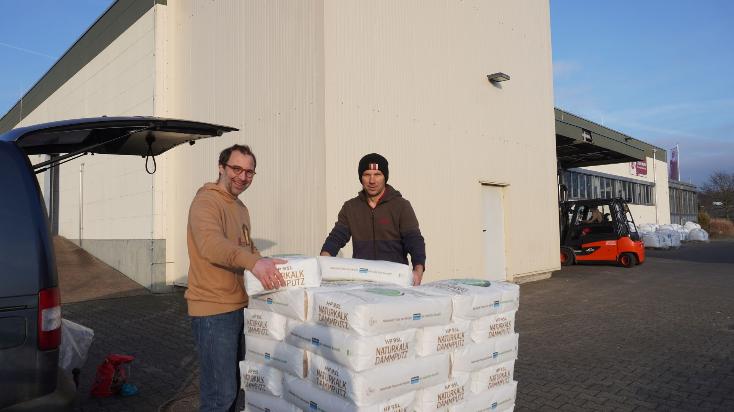
S: Yes, that would probably be the safest approach. I do recommend the type of insulation material. For example, I'm a big fan of lime insulating plasters. I like to recommend them. Usually people haven't heard of them, and then I say there's this or that manufacturer, you could have a look.
D: Would some kind of legal certainty that you're allowed to recommend products help you?
S: I don't think it's a bad thing at all that advice has to be product-neutral. I don't want lobbyists standing at my door saying: “Why don't you recommend my building material?” Then I'd constantly have post from Rockwool in my letterbox. I'm quite glad that's not the case. There's also still a ban preventing tradespeople from being energy consultants and installers at the same time. For example, as a carpenter I'm not allowed to be an energy consultant as well and then insulate the client's roof with the insulation material I advised on beforehand.
D: Sure, then there's no longer any control body and it's no longer product-neutral.
S: Exactly, I basically think it's good that it's like that. Of course I have favourite materials and I do drop a name now and then, but I never put anything in the written reports. They say 30 cm with thermal conductivity group 040, although I think that's already a hint. I could also write 24 cm with 034. I don't do that. I always use the 040 with a thicker insulation build-up, because I believe that gives clients the option of choosing natural building materials too. Back to your original question: in principle, I wouldn't think it a bad idea if the primary energy of building materials were somehow included in the assessment. However, I don't know exactly at what point it could be taken into account. It would also have to work via a points system. That's of course a lot of bureaucratic effort. I don't know how that would work. And then someone would also have to certify that the building material meets certain environmental criteria. When is it recommendable?
D: Exactly, the building materials would first have to undergo testing to get a score, and these points then add up in the building to a total x, and if you reach total y, you're better.
S: Yes, fine, but if I look at specific building materials, e.g. Thermohanf. They've built plastic support fibres into their hemp batts. Is that still a low-impact building material or not? I find that difficult to assess.
D: Yes, and then there are the transport routes. What does it mean if a material travels from Lower Saxony to the Netherlands to be defibred, then on to Baden-Württemberg to be processed into boards, and then back to Lower Saxony to be sold and installed here?
S: Yes, the transport issues are difficult too. Steico has its products manufactured in the Czech Republic. The most consistent approach here, I think, is straw bale construction, as with Dirk Scharmer, for example: he installs locally grown straw, clay plaster inside, lime plaster outside. There's nothing else, no membrane. But those are niches.
D: Yes, you can't tackle the housing shortage currently affecting Germany with that.
S: Another example: OSB boards. Is that a natural building material?
D: No, that's not a low-impact building material.
S: Well, it's a wood product and certainly has its place. But who knows what's in it.
D: A composite wood product, but those definitions simply don't exist yet. I'm always on the lookout for natural building materials that work. But then they have to have certification.
S: See, I wanted to bring you something. We were in Mallorca, and there on the beach there are those balls. Neptutherm sells them. We just collected them on the beach.
D: Yes, cool. But here in Germany a building material always has to be consistent, standardised; it also has to give the tradesperson certainty and a warranty. Unfortunately it's difficult to take a raw material collected in nature and turn it into a building material.
S: I don't really know how Neptutherm does it.
D: Steico Internal is also a composite product like OSB board. The boards are pressed and always bonded in 2 cm layers. It always has to be reasonably workable. Or Hiss Reet, where you used to work – that's a building material too, you can look into it and see what's in it.
S: Yes, it's an honest building material. However, it has to be transported from Turkey, and in terms of installation it's not quite as user-friendly as a softwood fibreboard. That's of course what the reed board has to compete with. The insulation value isn't quite as good and installation is more difficult.
D: Does Hiss have an approval?
S: Yes, Hiss Reet put a lot of time and work into that back then. The approval has also been extended again. Hiss Reet invested a relatively large amount of money in it and wanted to push the building material further. But it also has disadvantages and is simply expensive. Not competitive with softwood fibre, but yes, an honest natural material.
D: The costs come from the small quantities, and it goes round in circles. If the quantities were larger, we'd have a cultivation problem again. I often notice that in spring, when the reed simply isn't back here yet. S: You can also use seagrass.
D: That doesn't have an approval either. We insulated our entire house with seagrass, 10 bales in total. It's warm and good, but there's so much dust when installing it. I became a bit sceptical because the seagrass seemed very brittle to me and I don't know how it behaves when it settles. Still, I think the approach behind it with natural building materials is absolutely brilliant. No primary energy, untreated, collected, dried and ultimately disposed of. It's just in the way for the beach operators. That's how it should be done! When you think how many trees are felled for the Steico plants so that we can have internal insulation… A waste product like seagrass is much nicer. Or hemp, which grows incredibly fast and does the soil good at the same time.
S: Yes, this hemp fibre is also an honest natural product. They're people driven by conviction too, aren't they?
D: Yes, but also kings of the niche. Pure raw material processed into building materials: loose fill for internal insulation of timber-frame buildings as a dry raw material that you can process directly. Light clay for floors, excellent impact sound insulation! Really great!
S: Absolutely!
D: Thanks for the interesting conversation, Stefan!
S: Yes, thanks for the lovely evening!
D: Maybe we should do a podcast, it's fun chatting with you.