
Helmut Schamberger, a painter and applicator from Außerfern in western Austria, shares a long friendship with David Feldbrügge and an ongoing cooperation with the Lehm-Laden. They recently met again at the Denkmal trade fair. Here they talk about natural paints in the painting trade.
Dear Helmut, it's great that you found time right after the trade fair to talk about your work again in peace and quiet.
Conventional products are very widespread in the painting and decorating trade; do you only use products made from natural raw materials in your business, or do you sometimes use conventional paints as well?
I do also work with conventional paints, but very little now. I'm pleased that I've reduced emulsion paint to a minimum. My main focus is on lime plasters, and I work with a bit of clay too. When I do coats with lime putty paints, for example from Kreidezeit, they're very rewarding to apply and always give a lovely result.
My business is set up so that I mostly work on smaller areas, not thousands of square metres. But every now and then something conventional slips in. Those might be long-standing, nice customers for whom you can turn a blind eye. And then, when I see what working with conventional paints is like again, I know straight away why I actually use natural paints.
So you don't feel good about it at all?
It's that strange, sweetish smell. Some conventional products are of course easy to work with. But they're not really good. It can't be right that you keep having to hold your breath or air the room while you're working. Smelling freshly soaped lime on site versus a dispersion paint – there's simply no comparison.

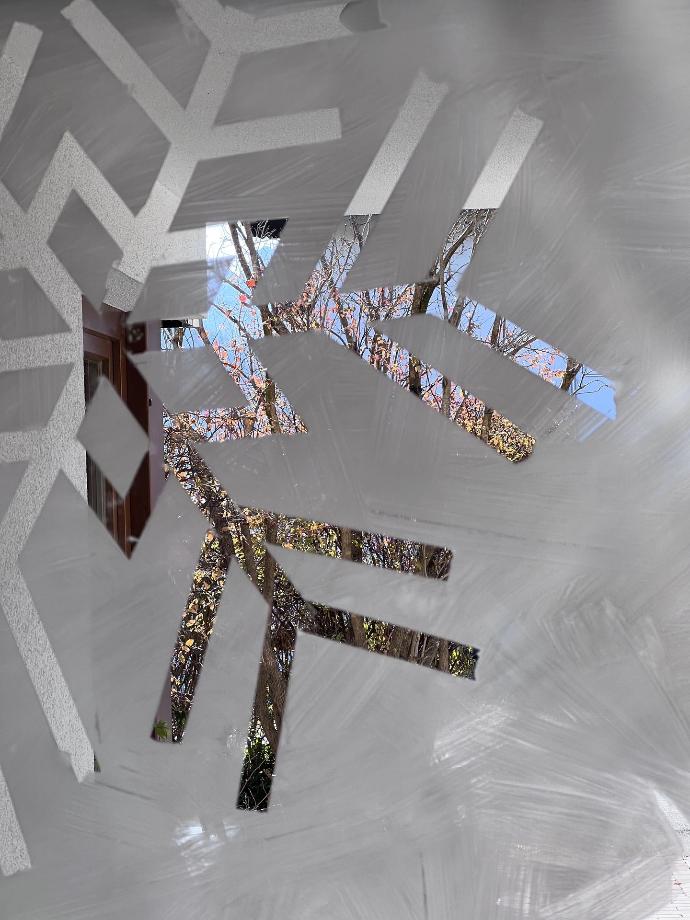
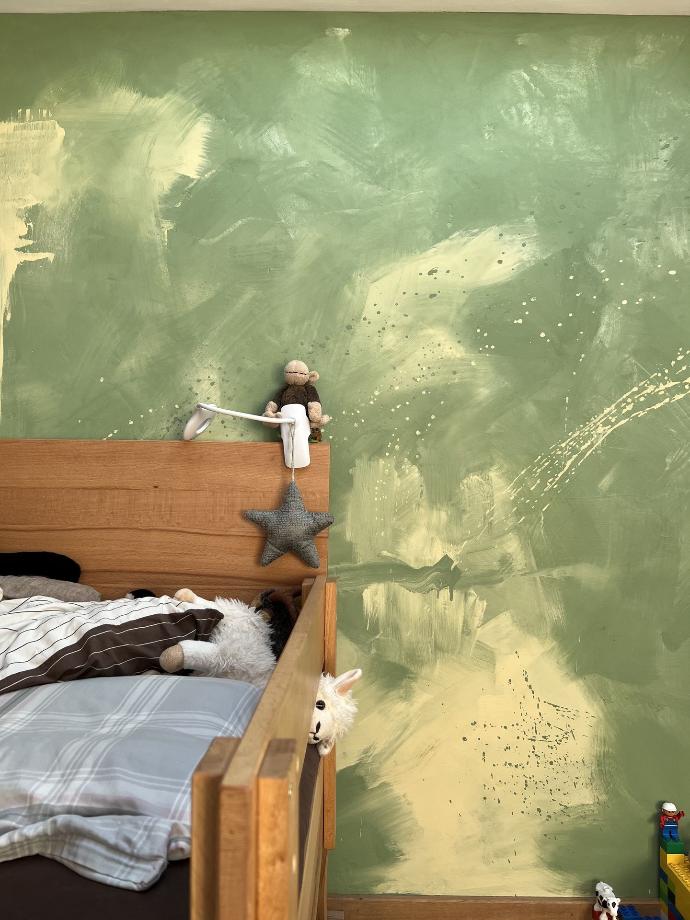
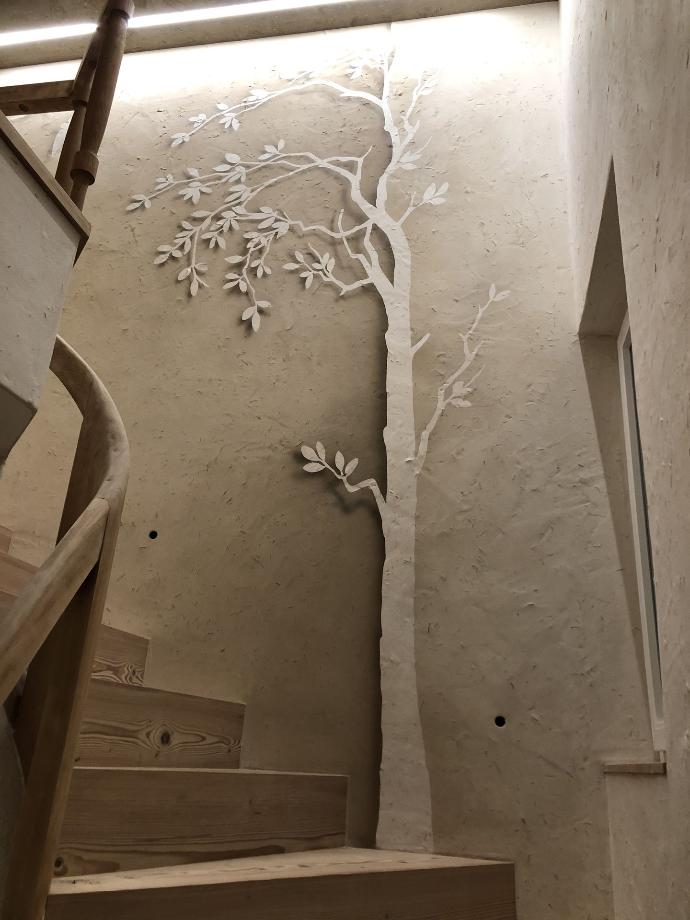
Painting and decorating is one of the trades in which a great deal of construction chemicals are used. Tiling might come close, or the areas of plastering and waterproofing. But here we're talking about all the surfaces that create people's living spaces.
Yes, exactly, it's in direct contact with the indoor air, so to speak.
What do you do in your business? Do you serve end customers who already live in their homes by renovating their houses for them?
Partly, partly. On the one hand it's selective, when people are already living there and I do the living room, bedroom or children's room. Or on the other hand new builds: those who want to afford it get everything done with natural building materials. Where, for example, you simply go right through with the Hessler, mesh and lime bonding plaster and create a beautiful surface.
And self-builders who want to do their own interior finishing also come to me regularly, simply to get advice on what options there are. Then I put together three or four variants, be it the somewhat more demanding clay, the somewhat simpler lime or at least just a coat of paint. Then people decide what suits them best. I provide the material and, if they want, I also come to the building site to help out with advice and practical support, work alongside them for a while and give tips. And only when they know enough and feel confident do I leave again, but I'm still available by phone for questions.
Yes, that's always nice too. I've often found that when clients work alongside you, they appreciate the work much more, because they simply know how much work goes into it. And they become more tolerant of mistakes, too.
Yes, we all appreciate that.
Back to your building sites for a moment. You said you do new builds, but you also renovate while people are already living there, and you work together with the customers. Which of these do you enjoy most?
Phew. Good question. It's all actually nice and each has something going for it. It's most exciting, of course, when you have an open-minded customer. Then new builds are usually interesting too, if you can contribute creatively and not everything is just painted white from start to finish. That definitely has its appeal.
But renovation is of course really great too: the room is actually the same, and yet it isn't. When you walk in, you often don't recognise it at all, including the feel of it and the energy it gives off afterwards. I think you get almost more of a before-and-after effect there than in new builds. When customers knew their old room beforehand and then discover the new one for themselves, they are even a bit more thrilled.
And working together with people, too – actually, it all has something going for it. I wouldn't want to do just one of those things all year round. Variety is the spice of life, isn't it? Being broadly based really does have something going for it. You always stay close to the material. That's the common thread running through it all.
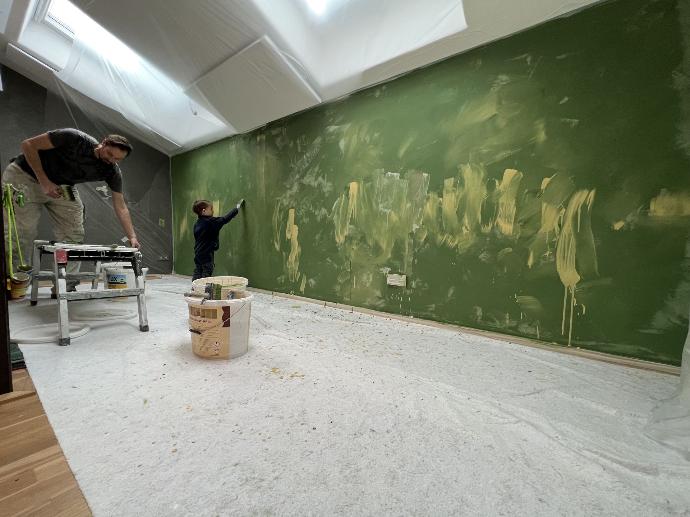
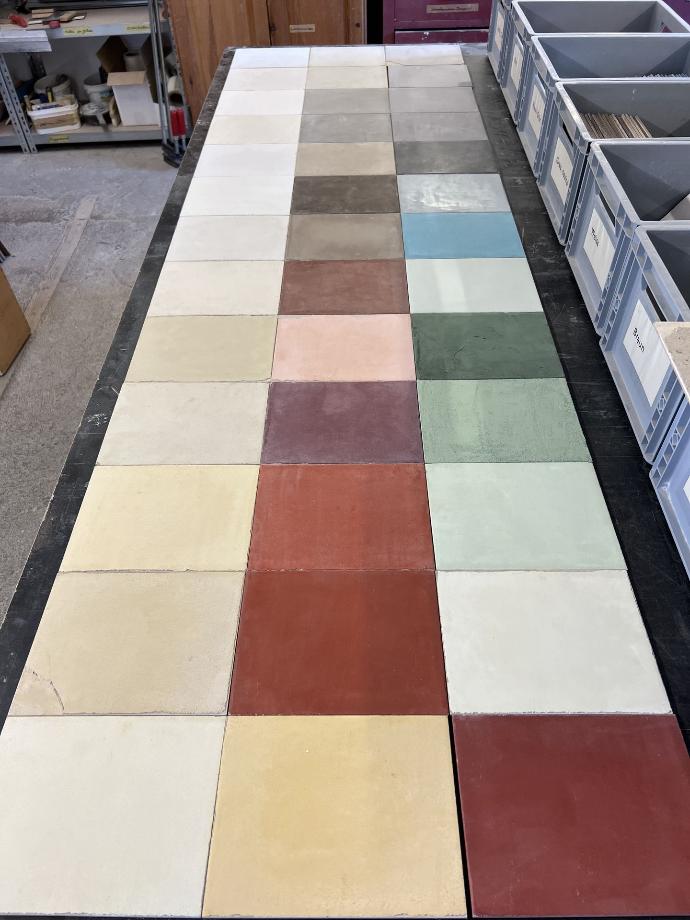
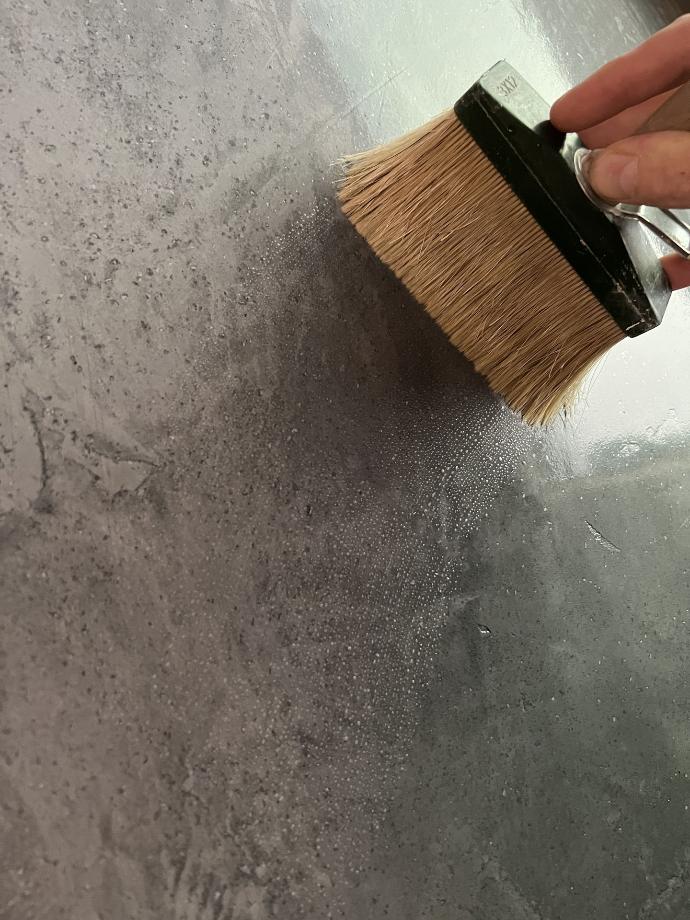

What would be your simplest and most important first tip for a painter who wants to move away from emulsion paint and start working with products made from natural raw materials? What should they look out for? And what are the arguments you find work best when promoting paints made from natural raw materials to customers?
It's of course the purity of the material itself. That's the main argument customers value, regardless of whether they have the work done or do it themselves. For those who care about that, the extra effort or extra cost is worth it. The trigger is often a problem. Every house has problem spots such as the window reveals that nothing could fix. And when, for example, mould remediation works this way, that's pretty convincing. A start has been made, and customers who have once had paint made from natural raw materials often don't want to go back.
Back to the ordinary painter who always uses emulsion paint and fills everything with gypsum: what would you say to him? Would you invite him to your building site to work alongside you for a while and show him how it can be done differently?
Yes, of course. At the moment I'm doing more plastering than painting. I'm not purely a painter.
Imagine the substrate has already been patched up, there are just chases and cracks in it. And before he starts with the standard stuff from the DIY store, I say to him: why not try this? How great and fine these materials are. And to show him: this won't fail today, you can carry on working with it tomorrow. It's nice when you can demonstrate what products like these can do. For example: a good substrate is prepared, then you go over it with water and you see it go ssssst – and the drop of water is gone. And on the other side a poor substrate, where you apply water and end up with a puddle on the floor. And the good substrate is only marginally more expensive than the run-of-the-mill stuff from the DIY store. And the skills are there too: you know how to hold the trowel properly, you just need to bear two or three things in mind and do a few things a bit differently. I'd be really fired up about that, of course.
At the moment I work alone and there's only so much my two hands can do, which is why I find self-build projects so lovely: you have lots of hands again. And what matters to me is that as many people as possible benefit from these things. I really like sharing my knowledge. I'm always open to that. If someone is curious, I always say: come along. I'm not the hen sitting on her egg, brooding away on her own, and I don't think in terms of competition in that sense. It's great if there are more of us. The market is growing, so there's still plenty of room for others.
That's lovely and also very common in the natural building materials sector. I hear it again and again. There isn't really any competitive thinking. We've now talked a lot about wall surfaces – do you also do wood surfaces, such as wooden floors, or do you also work outdoors?
Yes, when I do some woodwork outside, I use oils. Especially around windows, I make sure the old coatings are removed completely, and only then is the surface built up again with oil. In the long term, this makes maintenance much easier. Take on the extra effort once, and then things really do get easier. And façades? Yes, now and then I use the silicate paints from Beeck, depending on what the substrate allows. Oiling or laying floors is not actually something painters do in Austria.
So which paint would you recommend to a self-builder? Clay, lime or silicate paints?
I always like to argue in favour of silicate paint, because it has the rational arguments on its side. Clay paints are great too. They involve a little extra effort, but they're quicker to apply than lime putty paints. Those really make you work for it, because you simply have to rely on the brush. You can't use a roller any more.
So you prefer working with a roller?
Yes, it is. But of course the nicest surface comes from the brush. Nicely in a horizontal figure of eight. If there are two of you, one can apply with the roller and the other can follow behind and lay off with the brush. Or apply thinly with the roller and then do the finish with the brush, because it's so easy to touch up once you've lived there for a year or two. That gives a cloudy effect and the greatest charm.
That's always my recommendation too. I love this criss-cross application and the beautiful, evenly uneven texture it creates. And what about silicate paints? Which manufacturer do you rely on there? Which paints do you work with a lot?
Yes, with Biosil from Keim. Although ... now, after the trade fair, I'm definitely going to get a batch of Beeck, not just for the façade but for indoors too. It costs a euro more, but it's certainly worth it. But you are a creature of habit. And when you've already used a product in all sorts of situations and know it inside out, you feel accordingly that you're on safe ground. Switching manufacturers is always something of a hurdle. Although the change from one high-quality silicate paint to another high-quality silicate paint is certainly not as big as when a conventional painter switches from emulsion paint to clay or lime paint. That's a different challenge altogether.
When I first started getting to grips with these things, it involved a lot of reading, research and trial and error, even though I had always been open to and interested in natural building materials. I really had to feel my way forward, especially when the result is supposed to be perfect. From priming to achieve evenly absorbent substrates through to the finished surface – everything is different. You have to rethink all the details: acrylic sealant as the standard is suddenly no longer the option. You have to change your thinking and accept that everything is a bit more laborious. But in the long run, it makes sense.
Could you tell me a bit more about external thermal insulation composite systems? What approaches do you take there – internal or external insulation? What do you consider a sensible solution using natural building materials?
Well, in new builds it's clear that you avoid that sort of thing as far as possible. If it's already on the whole house, the question is whether anyone will really go to the trouble of removing it and getting that stuff off. Internal insulation is certainly a solution, but it's not very common here. Unfortunately, we don't have that many beautiful old timber-framed houses and other façades worth preserving, where you can then insulate the house “bit by bit”. I once insulated a poorly renovated rented flat from the inside with calcium silicate boards, but in general that rarely happens here. Privately, I built with hemp blocks and insulated the roof with wood wool. I don't do that professionally. Larger firms do external thermal insulation composite systems and drylining.
In Germany, many companies are working at full capacity and cannot find skilled workers – and in Austria? How would you assess the economic situation of the Austrian trades? How is your order book looking? Do you have a lot of work? Do you have and/or can you find employees?
Similar. Despite the fact that things are shifting a bit again now with financing and everything. In construction and the like, things are getting tighter. But painters have a broad range of work. You also work in occupied homes as a renovator and someone who makes things look nicer. Of course, that means it doesn't hit you as hard as it would if you depended solely on new builds. But here too, the dominant problem, regardless of the trade, is this: there is more work than there are good skilled workers. I'm glad I work on my own. We've organised ourselves here: we're a small catchment area here in Tyrol, with the German border on one side and the mountain range on the other. We tend to keep ourselves to ourselves here, which is probably why it's called Außerfern. Within this little microcosm, we've come together in a small working group. There are two or three others; we get in touch when something bigger comes up and decide whether we want to take it on together. That works well and reliably. And after the project, everyone goes their own way again.
How do you organise this network? Does one of you bring in the job and handle the arrangements with the client? And does one of you then work for the other at an hourly rate?
The best thing is if the client makes it possible for everyone to invoice directly.
Directly with the customer?
Yes. It varies. Either you include someone in your own invoicing and then receive an invoice from the partner business. Or everyone invoices directly. We arrange it depending on the set-up and the customer. For warranty purposes, for example, many want one point of contact rather than three. And there's often one person through whom the materials are ordered, and that's usually me.
How do you see the trend? It is becoming apparent right now that the economy may be heading downhill a bit again and that the big construction boom is over. Do you think that, with this slowdown, the boom in natural building materials will also decline, that it will stay the same, or that it will even grow in spite of it or because of it?
The trend is rising. This market is, after all, still a small niche by comparison. I do think the growth will continue; I'm actually sure of it. You stand out from the usual competitors and offer added value. If you're the copy of the copy of the copy, you'll certainly find it harder to get decent prices for your work, in other words to be worth the price. But if you go into more depth, as you do with the Lehm-Laden, you're now going to the very fundamentals of building. That's where natural building materials of course have the greatest advantage of all. It is perhaps still regarded as something of a luxury when a “conventional” building is upgraded with natural building materials.
Thank you very much for your candid words and for your open attitude to life and work. It is great and important when people from the field of building with natural materials reach out a hand to others and help them over into this broad and multifaceted field, where many more hands and minds are still needed.