Underfloor heating made from natural materials
The Lethermo system is an underfloor heating system based on natural materials – clay and wood, without adhesives. The clay panels hold the heating pipe, store the heat and release it evenly into the solid wood floorboards.
Low flow temperatures of 40 °C are enough to reach 48 W/m² – ideal for heat pumps. With a build-up height of just 45 mm, the system is also suitable for renovating older buildings. No screed, no long drying times.
At the end of its life, the system can be dismantled without destruction – the clay panels can be reused directly or composted as a raw material.
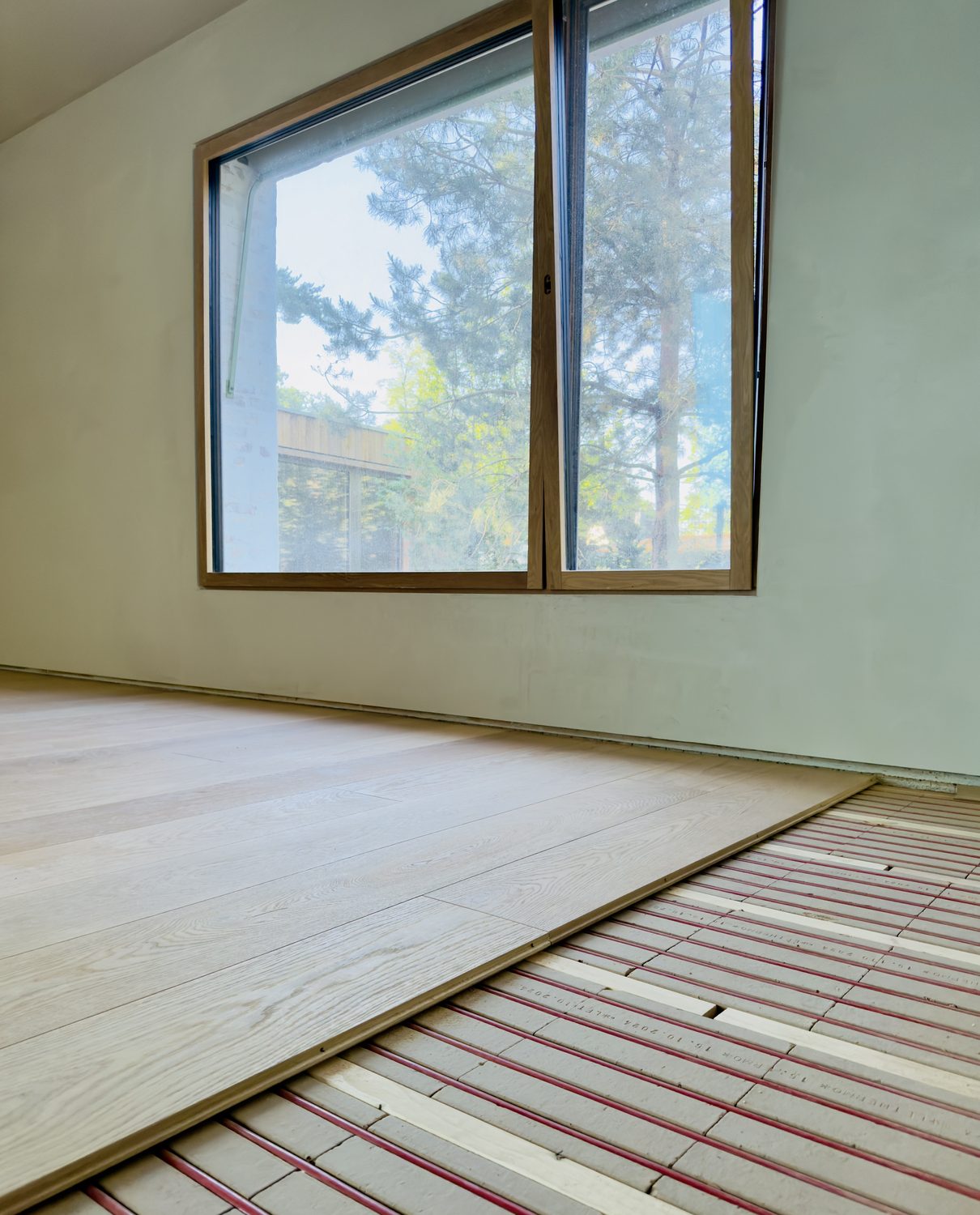
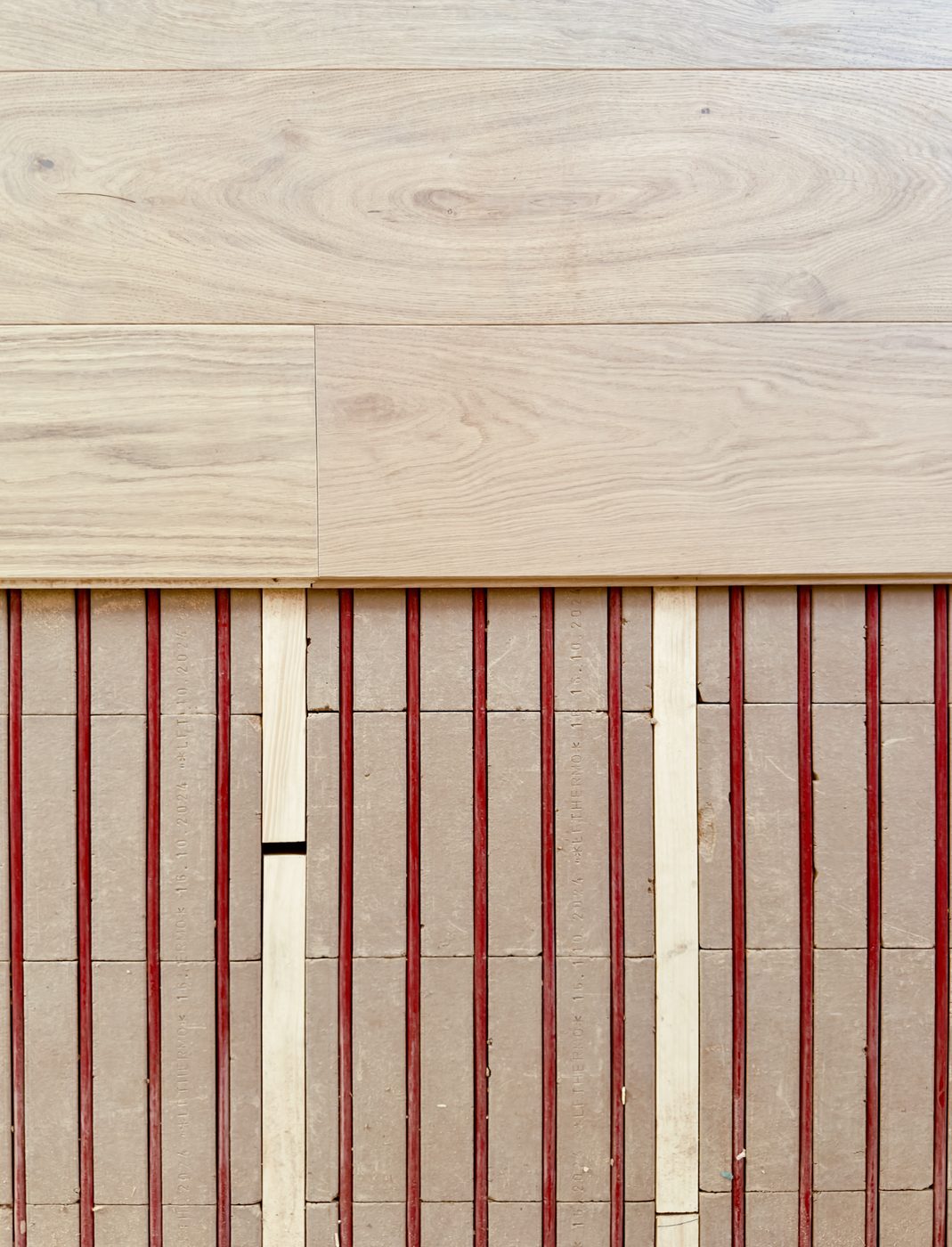
Von der Baustelle: Die Massivholzdielen werden direkt auf das fertig verlegte Lethermo Floor-System geschraubt.
Lethermo Floor and N+F
The Lethermo Floor system is designed for solid wood floorboards on battens. The clay panels cover around 82% of the floor area and hold the heating pipe directly. The remaining floor area is filled with Lethermo's clay fill.
The N+F version (tongue and groove) works in a suspended floor – with or without battens. Both versions meet the DIN EN 1264 standard and achieve up to 48 W/m² with hardwood floorboards at a 40/30 °C flow/return temperature.
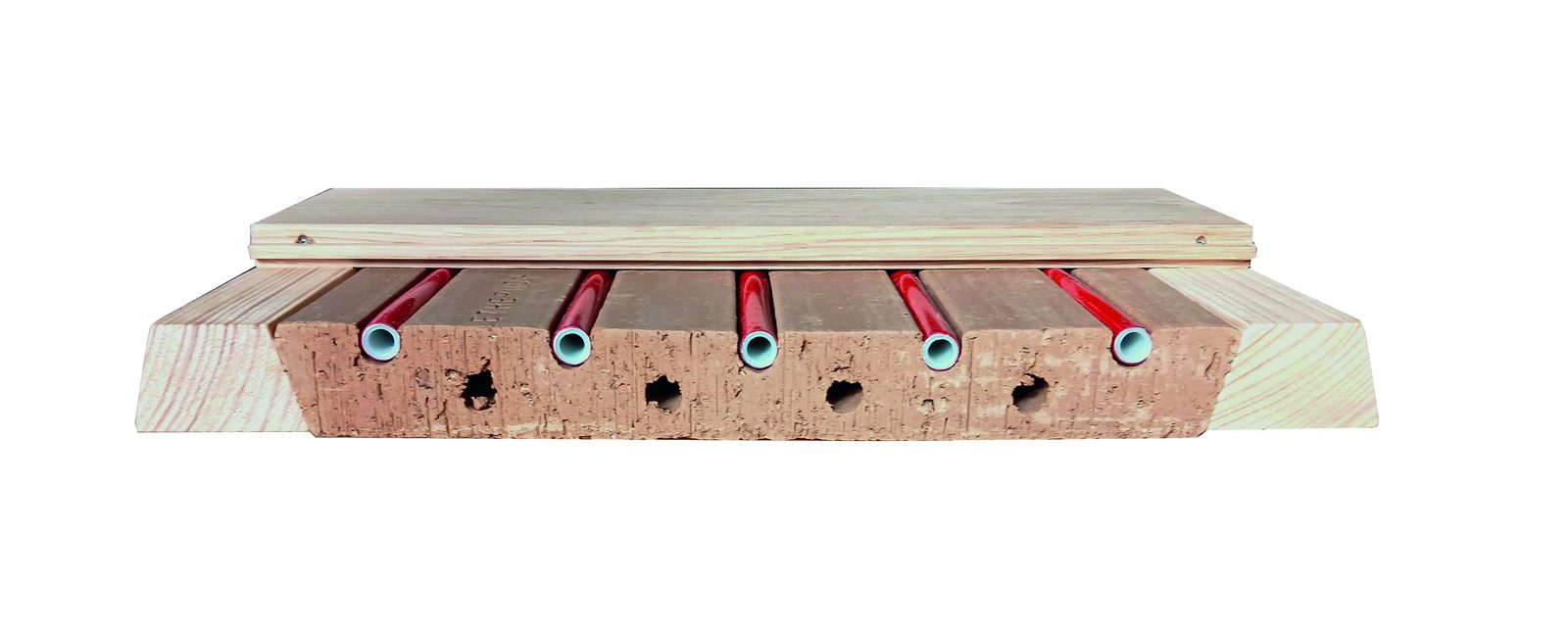
Lethermo Floor – Lehmplatten auf Lagerlatten, Wärmerohr in den Rillen, Massivholzdiele als Deckschicht.
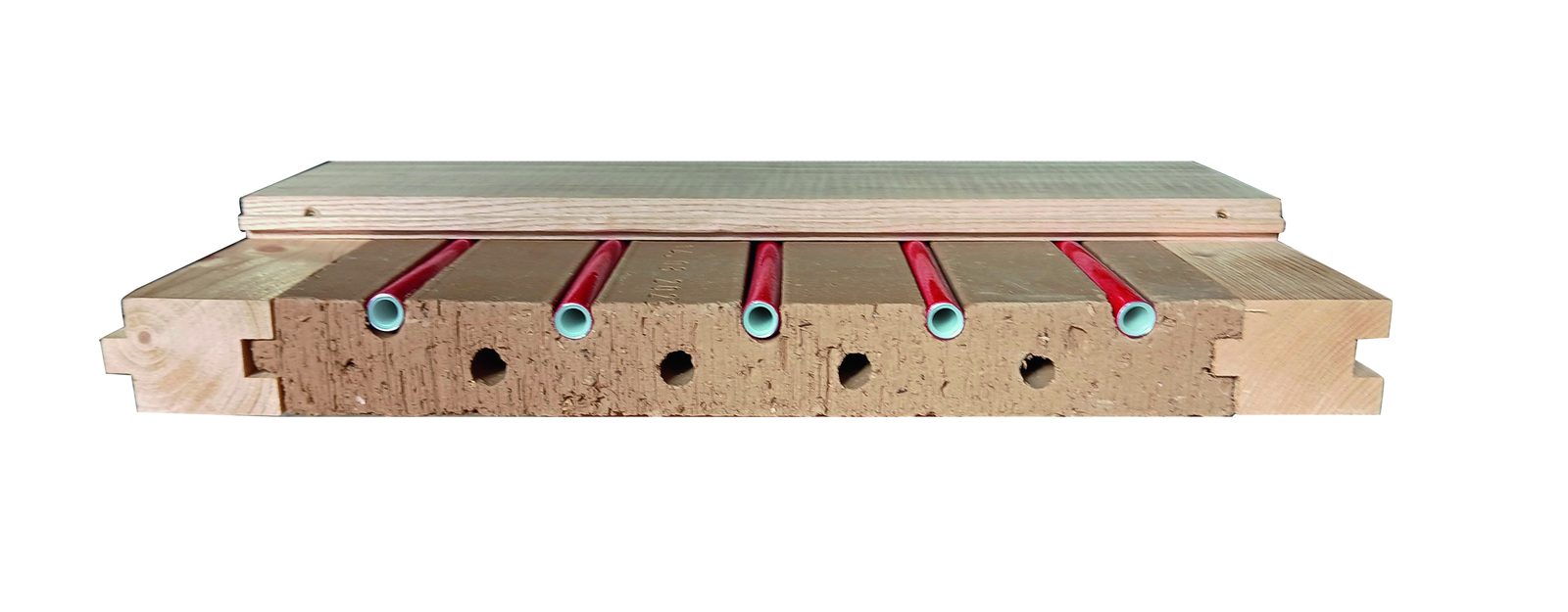
Lethermo N+F – Nut-und-Feder-Lehmplatten ohne Lagerlatten, für den Fehlboden.
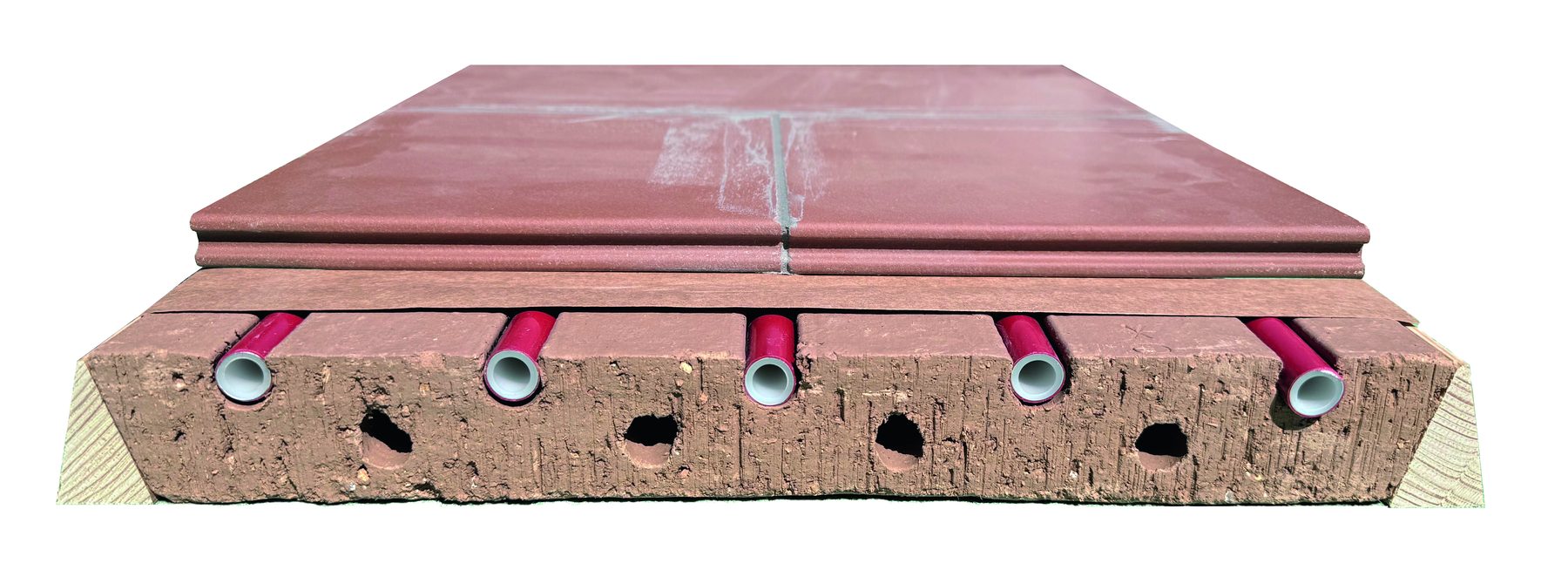
Lethermo Cera – N+F-Lehmplatten, darüber unglasierte Estrichziegelplatten als Trockenestrich für Fliesen und Naturstein.
Lethermo Cera – for tiles and levelled floors
If you don't want to lay solid wood floorboards, you can finish the Lethermo system with the Cera screed-tile layer. The unglazed screed tile distributes the load and the heat, creating a level base for tiles or natural stone.
The build-up for tiled floors:
- Lay Lethermo N+F clay panels on a Gutex Thermofloor or a hemp fleece (impact sound insulation) – connected via tongue and groove and laid with staggered joints.
- Insert a separating layer (paper)
- Lay Lethermo Cera screed tiles as a dry screed, fixed with Cera screed-tile adhesive
- Fliesen direkt mit dem Kholao Colle auf den Estrichziegelplatten verlegen
The Cera accessories – screed tiles and screed-tile adhesive – are perfectly matched to one another.
How installation works
- Prepare the substrate – determine the build-up height, lay a moisture barrier if needed, fit the edge insulation strips, then add the levelling fill and lay the impact sound insulation.
- Lay the clay panels – Floor version with battens; N+F version without battens, connected directly via tongue and groove.
- Insert the heating pipe – into the grooves of the clay panels, connected to the heating circuit manifold by a qualified installer, including a pressure test.
- Lay the floor covering – Floor/N+F: solid wood floorboards directly onto the battens; for tiles: lay Lethermo Cera screed tiles as a dry screed on the N+F panels.
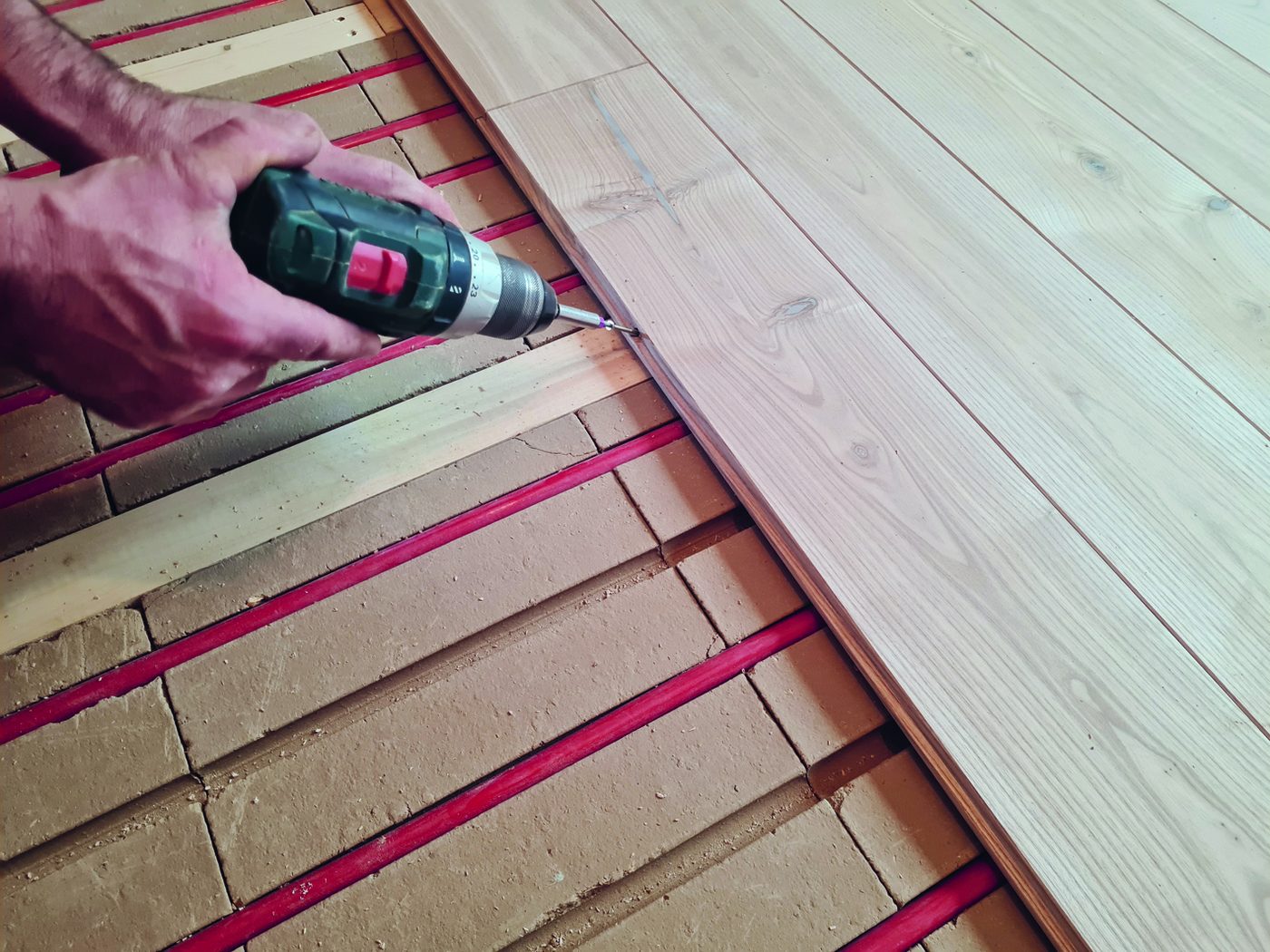
Die Massivholzdiele wird direkt auf die Lagerlatten geschraubt – kein Estrich, keine Trockenzeit.
Für massive Decken und Holzbalkendecken
Ob massive Decke oder Holzbalkendecke im Altbau: Eine ausgleichende Schicht aus lastabtragender Trockenschüttung bzw. Lehmsteinen und eine Holzfaserdämmung schaffen einen ebenen, tragfähigen Untergrund für das Lethermo Floor-System. Die Aufbauhöhe bleibt gering, und die Decke gewinnt zusätzliche Masse für Schall- und Wärmespeicherung.
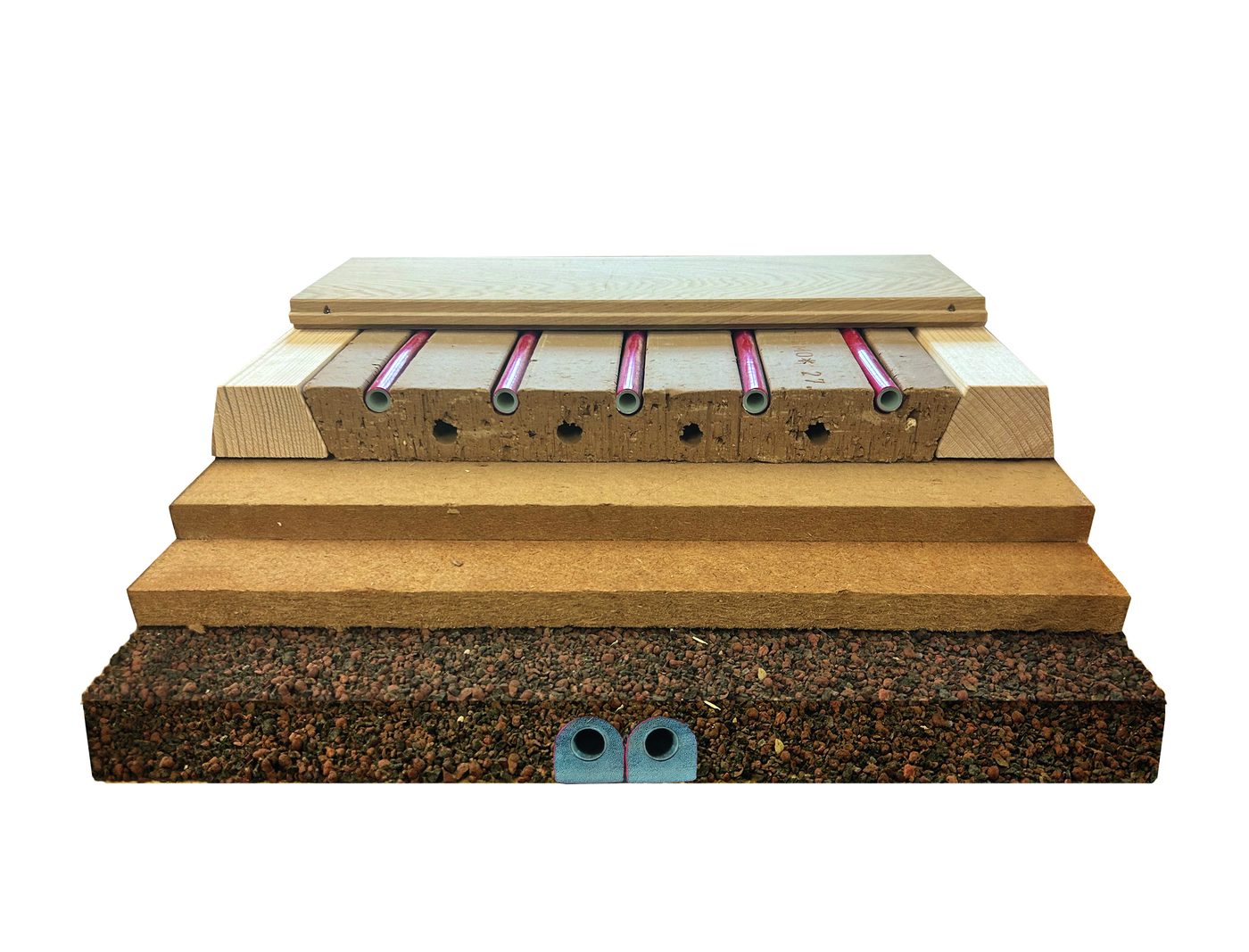
Auf massiver Decke: Lehmsplitt-Schüttung, zweilagige Holzfaserdämmung, Lethermo Floor mit Wärmerohr, Massivholzdiele.
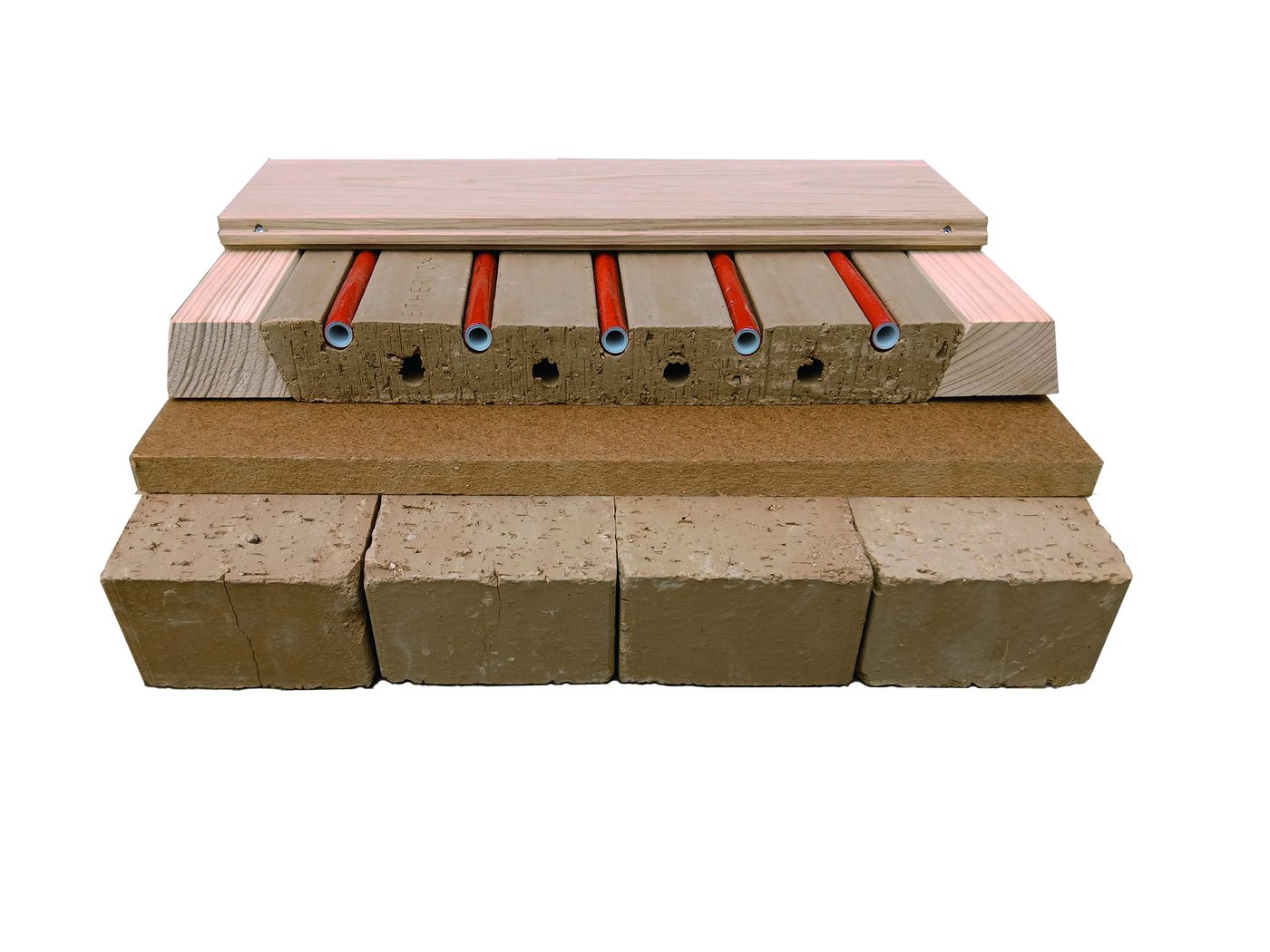
Auf Holzbalkendecke: Lehmsteine und Holzfaserdämmung als Ausgleich, darüber das Lethermo Floor-System.
Heating and cooling with one system
The Lethermo system can not only heat but also cool in summer – through the same heating pipe, simply using cold instead of warm water. This requires a heat pump that can also actively cool. It is designed according to DIN EN 1264-3 with dew point control, so no condensation forms on the floor.
- Cooling capacity at standard temperature difference (8 K): approx. 20–24 W/m² (depending on floorboard type), at 70 mm laying spacing
- A dew point sensor with control unit is required – reliably prevents condensation
- Same installation as for heating mode – no additional pipe system required

Wohlfühlwärme auf dem Massivholzboden – im Winter warm, im Sommer angenehm temperiert.
Technical data
| Dimensions (L × W × H) | 358 × 250 × 45 mm (± 2 mm) |
|---|---|
| Weight | approx. 75 kg/m² |
| Compressive strength | 12.3 N/mm² |
| Heat output (40/30 °C, 70 mm) | 48 W/m² (hardwood) |
| Heat output (40/30 °C, 140 mm) | 32 W/m² (hardwood) |
| Heat output (45/37 °C, 70 mm) | 68 W/m² (hardwood) |
| Heat output (45/37 °C, 140 mm) | 44 W/m² (hardwood) |
| Max. heating circuit | 8.5 m² (70 mm) / 17 m² (140 mm) |
| Heating pipe | PE-RTII/AL/PE-RTII, 14.4 × 2.2 mm |
| Pallet | 12.88 m² / EURO pallet |
| Standard | DIN EN 1264 / DIN EN 1264-3 (cooling) |
Advantages at a glance
- pure clay panels – completely natural materials
- Low flow temperature – ideal for heat pumps
- Suitable for renovation and new builds – only 45 mm build-up height, no screed
- Reversible – can be removed without damage, reusable or compostable
- Cooling possible – heating and cooling with one system
- Room climate – humidity regulation, impact sound reduction
- DIN EN 1264 certified
Frequently asked questions
How high is the build-up height?
Just 45 mm (± 1.5 mm) – also suitable for renovating older buildings. Impact sound insulation is not yet included. Good impact sound protection can be achieved with a 5 mm hemp fleece or a Gutex Thermofloor panel.
Is the system also suitable for tiled floors?
Yes, via the Cera version with screed tiles as a dry screed. The screed tiles form the dry screed that serves as the base for your tiles.
Can the system also cool?
Yes – provided a heat pump capable of cooling is available. See the "Heating and cooling with one system" section.
How humid should/must the room be during installation?
Before laying the floor covering, the heating should run for a few days until a relative humidity of 45–55% is reached (check with a hygrometer).
Is the system reversible?
Yes – the clay panels are compostable and reusable, with no bonding to the substrate.