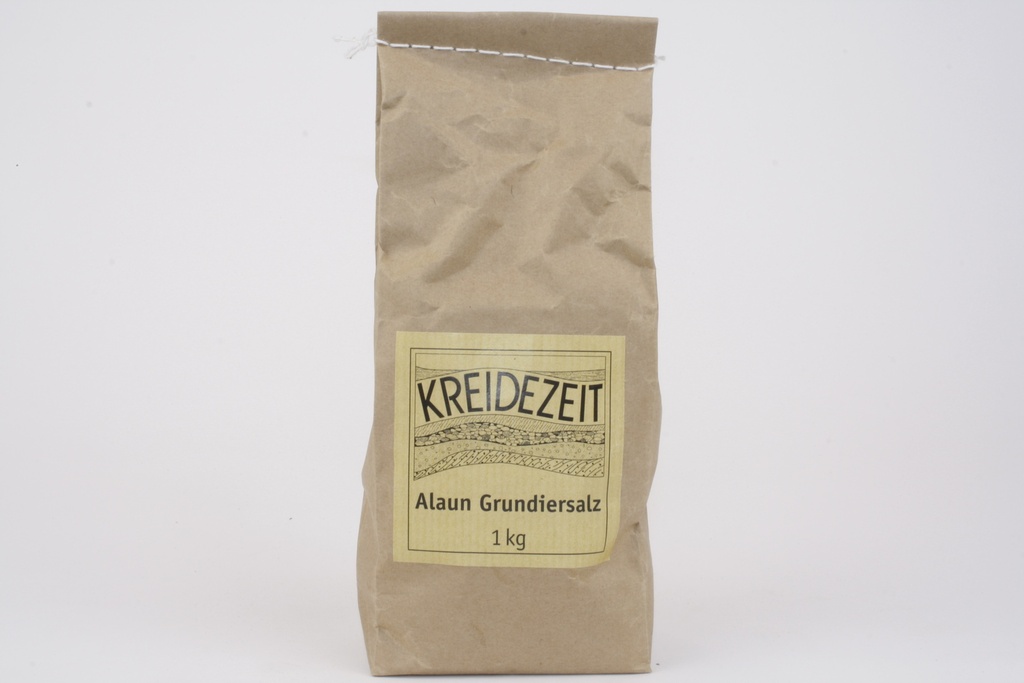
Alum salt primer
Alum (potassium aluminium sulphate) as a barrier primer against bleed-through discolouration and stains from the substrate – water marks, yellowing from old paste residues and similar. Dissolved in warm water, brushed on. Only slightly reduces vapour uptake. Coverage: depending on substrate absorbency, 1 kg covers approx. 30–100 m² per coat (equivalent to 10–30 g salt/m²).
KREIDEZEIT Alum Primer Salt serves as a blocking primer against bleed-through discolouration and stains from old substrates (water marks, yellowing substances from paste residues). The blocking effect is based on the reaction with lime that has not yet set, the closing of the plaster capillaries through recrystallisation and its poor solubility in cold water.
Unlike barrier primers, which are mostly solvent-based and vapour-tight, alum only slightly impairs the vapour absorption of the substrate. Alum is generally not effective on old, carbonated plasters or against nicotine staining.
Properties
- Salt for dissolving in warm water
- blocks water-soluble discolouration and yellowing substances
- only slightly impairs the vapour absorption of the substrate
- highly vapour-permeable: sd value < 0.01 m (DIN EN ISO 12572)
- solvent-free, odourless
- reduces absorbency, hardening
- acidic (pH 3–3.5 in a 10% solution)
- vegan
Suitable substrates
Completely dry, absorbent substrates, ideally fresh lime plaster or limewash that has not yet carbonated. Do not apply to acid-sensitive surfaces (marble, soapstone).
Application & Processing
Mixing: Dissolve approx. 100 g of primer salt per litre of warm water while stirring (approx. 5 minutes). A sediment of salt crystals indicates saturation and is not used.
Application: The substrate must be completely dry and absorbent. Apply the solution until saturated (brush or spray, do not roll). Minimum application temperature 8 °C. Allow to dry completely and brush off any excess salt crystals.
Further work: Paint over with KREIDEZEIT Slaked Lime Paint, Lime Bonding Plaster or Lime Smoothing Plaster, or apply a thin coat (1–2 mm) of plaster. After applying Casein Primer, Vega Wall Paint, Clay Paint, Clay Brush-on Plaster or Distemper can also be used. Ensure rapid drying.
Drying: Dry and ready for overcoating after 24 hours at the earliest.
Technical data
| Preparation | approx. 100 g per litre of warm water |
| pH | 3–3.5 (10% solution) |
| sd value | < 0.01 m (DIN EN ISO 12572) |
| Application | apply by brush/spray, do not roll |
| Drying | after 24 h at the earliest |
Full declaration
100 % potassium aluminium sulphate · 12 H₂O. When using the product, observe the complete product information (technical data sheet and safety data sheet).
Note: The solution is slightly acidic – avoid splashes on acid-sensitive components (marble, soapstone, metal) or cover them. Observe the safety data sheet.
Frequently asked questions
What does alum help against?
Against water-soluble discolouration from the substrate: water stains, yellowing substances from old paste residues and the like. Alum does not usually help against nicotine stains.
Why doesn't it work on old plaster?
The sealing effect depends on the reaction with lime that has not yet carbonated. On old, fully carbonated plaster, alum has hardly any effect.
Can I then use any paint?
Kalk products can be applied directly. For casein, clay and distemper paints, additionally prime with casein primer. Do not apply thick layers of filler, as the moisture could redissolve the alum and dyes.
Is successful application guaranteed?
No, but with professional application the chances of success are high enough to make a trial worthwhile.
Handelsmarke Adresse
Kreidezeit Naturfarben GmbHKassemühle 3, 31195 Lamspringe, Deutschland
+49 5060 6080650
info@kreidezeit.de