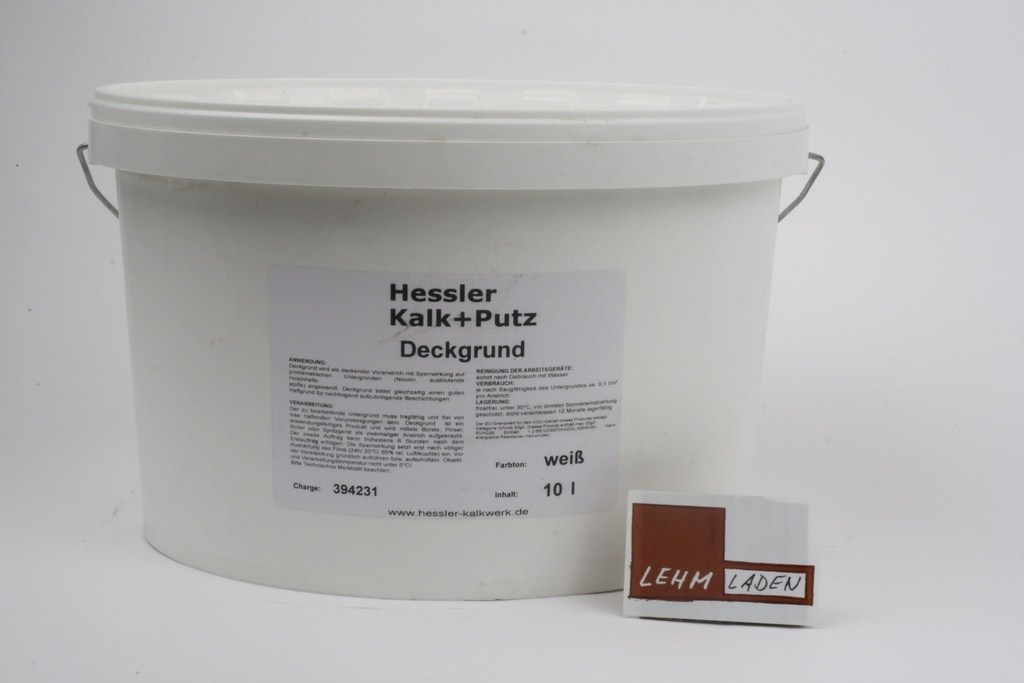
The barrier primer is used on inhomogeneous substrates where good adhesion and sealing of the substrate are required. On chimneys and old gypsum substrates it is definitely advisable to use this primer.
The barrier primer forms a continuous layer and at the same time provides a surface that can be plastered. According to the official classification, the barrier primer is vapour-permeable. Vapour permeability is calculated from the sd value and the layer thickness. With an sd value of 0.27 m and a layer thickness of 0.5 mm, as is usual for coatings, this results in a µ value of 480. The µ value can then be used for classification. From as little as 500 µ, vapour permeability is regarded as severely restricted. The sd value of 0.27 m sounds far more harmless, which is why conventional products usually state only the sd value, making it harder for the end user to compare.
Ordinary builders' merchants only advertise that such a product is vapour-permeable; how vapour-permeable it actually is can only be reliably confirmed by a specialist building materials retailer.
The barrier primer is used for subsequent plasters. The application thickness of the subsequent plasters should not exceed 5 mm.
Consumption depends on the substrate and should be calculated at 100 ml/ m². Apply undiluted with a ceiling brush or roller; two coats are possible, and further work is possible after 12 hours.
**Barrier primer is not a natural lime product; it serves to prepare unsuitable plaster substrates for a further plaster build-up with mineral building materials. The barrier primer is not manufactured by Hessler, and a full declaration is not available. I recommend cleaning the substrate, milling or sanding it if necessary, and then preparing it for plastering with Fixativ or Naturkalk-Grundierung (lime primer). This is better than using a barrier primer.**