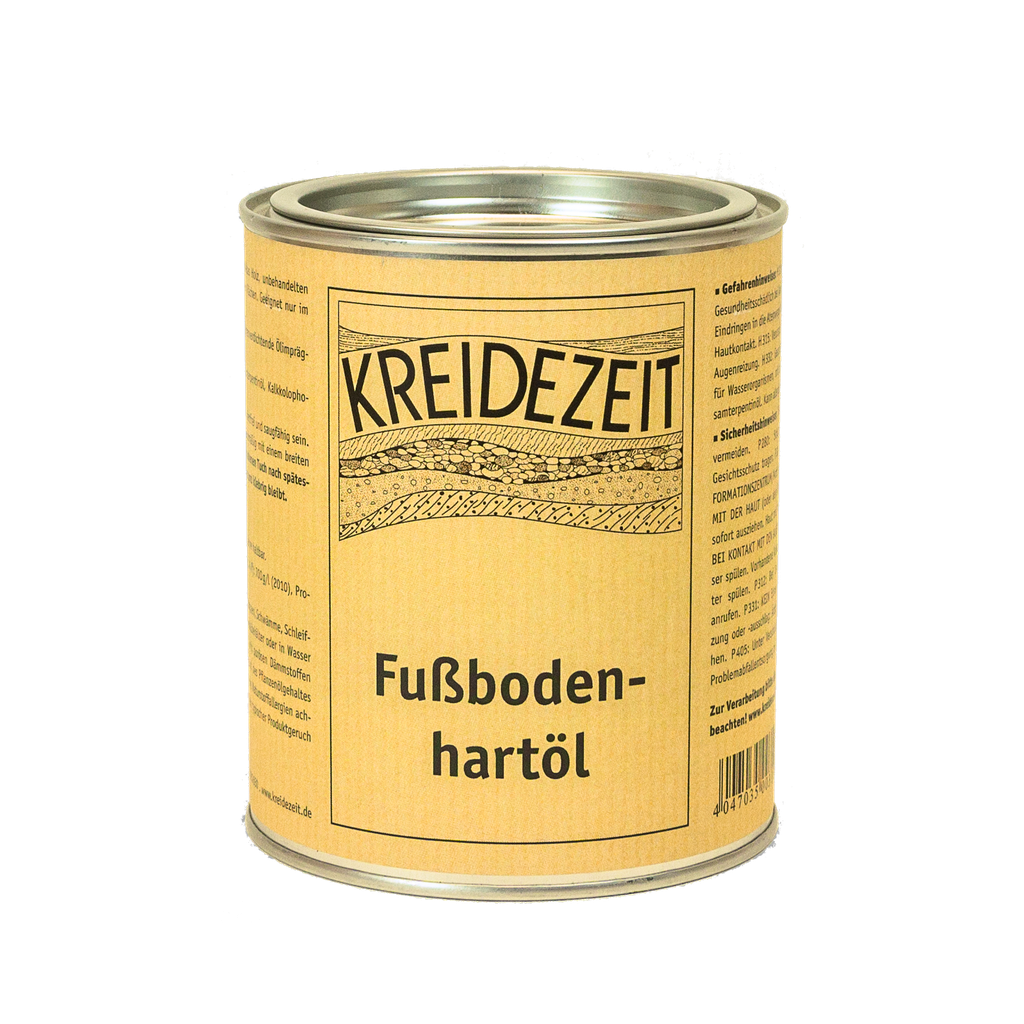
Floor hard oil
Universal hard oil for interior timber – hard-wearing protection for floors, worktops, tables, furniture, beams and panelling. Solvent-borne, deep-penetrating, tintable with KREIDEZEIT pigments. Toy-tested (EN 71-3), vegan. Coverage: approx. 0.06 l/m² per coat, depending on substrate absorbency; 750 ml covers approx. 12 m².
KREIDEZEIT Hard Floor Oil is a universal oil for interior wood that has proven itself for over 25 years. Thanks to its balsam turpentine oil content, it is suitable for all types of wood, including tannin-rich and dense timbers.
The high linseed oil content provides a long open time and deep penetration into even the finest pores. Floor hard oil consists exclusively of plant oils and resins; it can be tinted as required with KREIDEZEIT earth and mineral pigments.
Properties
- resistant to foot traffic, dirt- and water-repellent
- transparent, honey-toned, deepens the wood tone
- solvent-based, very economical
- does not crack or become brittle, easy to repair
- antistatic, warm to the touch
- excellent penetration
- suitable for children's toys in accordance with EN 71-3
- resistant to saliva and perspiration according to DIN 53160
- cobalt-, lead- and barium-free
- the drying constituents are linseed oil and stand oils – no alkyd resins made from rapeseed, soya or sunflower oil
- vegan
Suitable substrates
Untreated or previously oiled wood in the stated area of application. Not on varnished or foil-laminated surfaces. A test area is recommended.
Application & Processing
Preparation: Clean the wood and remove dust; initial sanding with P 80–120 grit (no finer, otherwise the wood will absorb too little oil). Shake the container before use and apply undiluted (for dense or tannin-rich woods, dilute the 1st coat with approx. 10 % balsamic turpentine oil).
1st coat: Apply thinly and evenly, leave to soak in for 10–20 minutes, then remove all oil that has not been absorbed with a lint-free cloth until the surface has an even silk-matt finish.
Intermediate sanding: Only if the surface has dried rough (grit P 100–120 in the direction of the grain), then remove the dust.
2nd coat: As for the first coat.
Tools & cleaning: Varnish brushes, wide wall brushes, cotton cloths, short-pile rollers. Clean tools immediately with gum turpentine, then with Oliven Pflegeseife or Korfu Seife.
Technical data
| Use | Floors, worktops, tables, furniture, beams, cladding (interior) |
| Coats | usually 2, with drying time between coats |
| Thinning | undiluted; dense/tannin-rich woods: 1st coat with approx. 10 % gum turpentine |
| Drying | can be recoated after approx. 24 h (20 °C), fully cured after approx. 4 weeks |
| Tests | EN 71-3 (toys), DIN 53160 (resistant to saliva/perspiration) |
Full declaration
Linseed oil, gum turpentine oil, linseed stand oil, tung oil stand oil, rosin glycerol ester, manganese drier. When using the product, observe the complete product information (technical data sheet and safety data sheet).
Note: Risk of spontaneous combustion: lay out oil-soaked rags and sanding dust flat to dry or keep them in water, then dispose of them. Full curing takes approx. 4 weeks – treat the surface gently during this time. Observe the safety data sheet.
Frequently asked questions
How do I apply oil correctly?
Apply thinly and evenly with a brush, cloth or short-pile roller, allow to soak in for 10–20 minutes, then remove all oil that has not been absorbed with a lint-free cloth. The oil must penetrate the wood completely and must not form a film.
How many coats do I need?
On untreated wood, generally two coats with drying time in between; sand lightly between coats if necessary. For woods rich in tannins (e.g. oak), dilute the first coat with approx. 10 % balsam turpentine oil.
Can I tint the oil?
Yes, with KREIDEZEIT earth and mineral pigments. First grind the pigments with a little oil until free of lumps, then stir them in. See the colour chart “Pigments in Oil”.
Why does the oil smell as it dries, and why does it yellow in dark areas?
When plant oils dry, a characteristic odour develops, which fades over time. In areas with little incident light, dark yellowing occurs – this is normal with linseed oil products.
Handelsmarke Adresse
Kreidezeit Naturfarben GmbHKassemühle 3, 31195 Lamspringe, Deutschland
+49 5060 6080650
info@kreidezeit.de