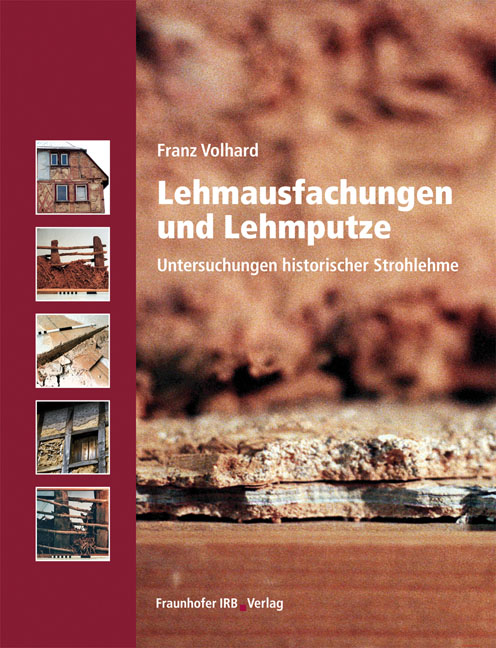
Lehmausfachungen und Lehmputze
Untersuchungen historischer Strohlehme, Sehr viel Information zu Lehmausfachungen und Lehmputzen
We have not provided a data sheet for this product
The tradition of building with clay in Germany and northern Europe is that of timber-frame construction. The infill was usually »straw clay«, a plastic mixture of clay with stabilising straw, applied in countless regional variations.
Renewed interest in clay as a building material gives rise to considerable uncertainty in practice, because when attempting to replicate the historical model, one finds that the living tradition of clay building techniques has been interrupted and one has to rely on information in the literature. The quality of an infill does not depend solely on the composition of the clay; it is determined above all by the application technique.
On the occasion of the repair and conversion of the "Gothic House Römer 2-6" in Limburg, its straw-clay infill panels from different periods – from the 13th to the 18th century – were systematically examined, with the aim of gaining practically usable guidelines for new infill work.
This specialist book represents the first attempt to cover the subject as comprehensively as possible. Only by relating all the individual characteristics to one another, such as bulk density, straw content, application technique, adhesion, assessment of qualities etc., can an overall picture emerge.
My opinion: A small book packed with information. Very in-depth examinations of various clay infills, with many pictures, tests, experiences and recommendations. All in all, a book that every timber-frame house owner should have (at least skim-) read once.
Handelsmarke Adresse
Fraunhofer IRBNobelstr. 12, 70569 Stuttgart, Deutschland
+49 711 9702500
sabine.leinweber@irb.fraunhofer.de