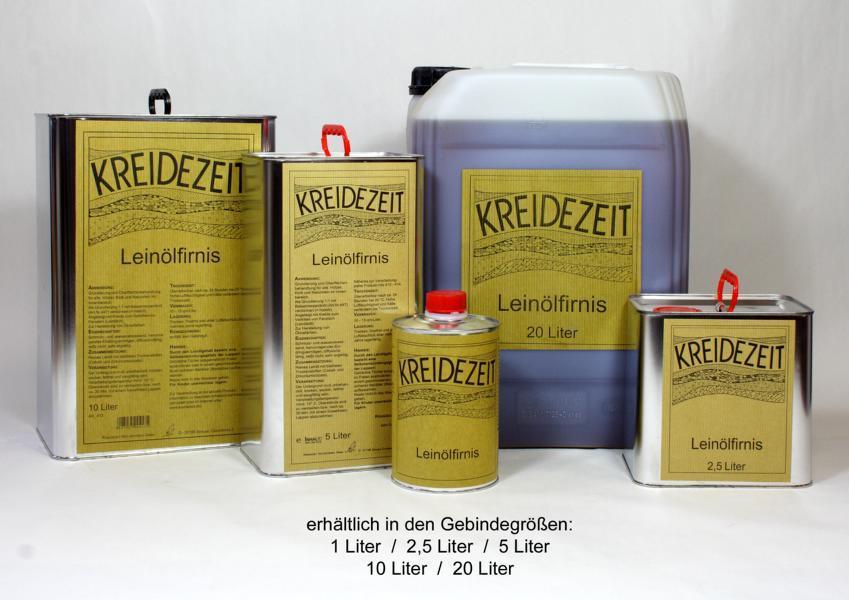
Boiled linseed oil
Solvent-free linseed oil varnish for lightly used interior timber – furniture, doors, beams, panelling. As a primer (1:1 with balsam turpentine) for KREIDEZEIT stand-oil paints and wood glazes and for making your own oil paints. Vegan. Coverage: approx. 0.050–0.100 l/m² per coat – 500 ml ≈ 10 m², 1 l ≈ 20 m², 2.5 l ≈ 50 m², 5 l ≈ 100 m², 10 l ≈ 200 m².
Linseed oil is the key raw material in oil-based paints; it is cold-pressed from linseed and dries by absorbing oxygen from the air. With added driers (boiled linseed oil), it dries at moderate temperatures in 24–48 hours instead of weeks.
KREIDEZEIT Linseed Oil Varnish -solvent-free- is used undiluted as a surface protection for interior timber subject to light wear. Diluted 1:1 with balsam turpentine oil, it serves as a half-oil primer for stand oil paints and wood glazes. It can also be used to make your own oil paints.
Properties
- solvent-free
- Surface protection for timber subject to low stress (interior)
- Primer (1:1 with balsam turpentine oil) for stand oil paints/wood stains
- Raw material for making your own oil paints
- transparent, deepens the colour of the wood
- does not crack or become brittle, easy to repair
- antistatic, warm to the touch
- excellent penetration
- suitable for children's toys in accordance with EN 71-3
- resistant to saliva and perspiration according to DIN 53160
- cobalt-, lead- and barium-free
- the drying constituents are linseed oil and stand oils – no alkyd resins made from rapeseed, soya or sunflower oil
- vegan
Suitable substrates
Untreated or previously oiled wood in the stated area of application. Not on varnished or foil-laminated surfaces. A test area is recommended.
Use & Application
Preparation: Clean the wood and remove dust; initial sanding with P 80–120 grit (no finer, otherwise the wood will absorb too little oil). Shake the container before use and apply undiluted (for dense or tannin-rich woods, dilute the 1st coat with approx. 10 % balsamic turpentine oil).
1st coat: Apply thinly and evenly, leave to soak in for 10–20 minutes, then remove all oil that has not been absorbed with a lint-free cloth until the surface has an even silk-matt finish.
Intermediate sanding: Only if the surface has dried rough (grit P 100–120 in the direction of the grain), then remove the dust.
2nd coat: As for the first coat.
Tools & cleaning: Varnish brushes, wide wall brushes, cotton cloths, short-pile rollers. Clean tools immediately with gum turpentine, then with Oliven Pflegeseife or Korfu Seife.
Technical data
| Application | Interior furniture/doors/beams; priming; making oil paints |
| Composition | solvent-free |
| Drying | approx. 24–48 h at moderate temperatures |
| Half oil | 1:1 with balsam turpentine oil |
| Tests | DIN 53160 |
Full declaration
Linseed oil, driers (manganese drier). Observe the complete product information (technical data sheet and safety data sheet) during application.
Note: Risk of spontaneous combustion: lay out oil-soaked rags and sanding dust flat to dry or keep them in water, then dispose of them. Full curing takes approx. 4 weeks – treat the surface gently during this time. Observe the safety data sheet.
Frequently asked questions
What is the difference between linseed oil and boiled linseed oil?
Boiled linseed oil is linseed oil with added driers. It dries in 24–48 hours instead of several weeks.
What can I use linseed oil varnish for?
Undiluted as a surface protection for interior wood subject to light wear, mixed 1:1 with balsam turpentine oil as a primer, or for making your own oil paints.
Do I have to remove the excess?
Yes. Wipe off all oil that has not soaked in after 10–20 minutes, otherwise sticky/glossy patches will remain.
Does boiled linseed oil yellow?
Dark yellowing occurs on surfaces exposed to little light – this is normal for all linseed oil products.
Handelsmarke Adresse
Kreidezeit Naturfarben GmbHKassemühle 3, 31195 Lamspringe, Deutschland
+49 5060 6080650
info@kreidezeit.de