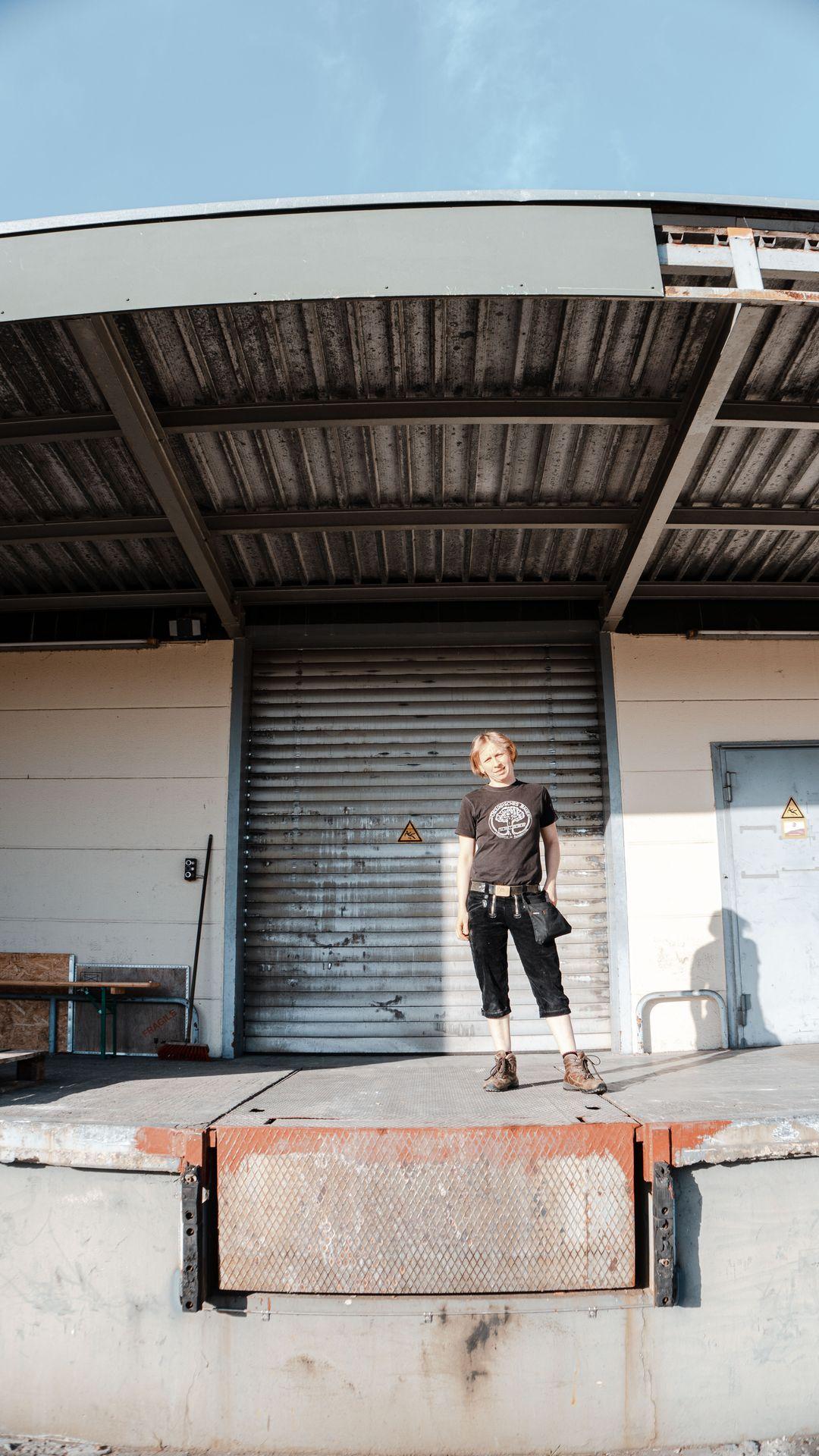
Hello Anna, great to have you here! You have been a self-employed clay builder for 12 years, you co-organised this year's meeting of women in the building trades and you are committed to greater visibility and networking for women in the construction industry.
Hello, thank you very much for your interest and for the invitation to Hitzacker!
When did you know that you wanted to work in the building trades? Who or what inspired you to do so?
When I was young I had neither male nor female role models and came to the trade more or less by chance. I did the basic vocational training year in woodwork in Lüneburg. After that I did my apprenticeship at a joinery in Potsdam.
How did you get from joinery to clay construction?
I went on the traditional journeyman's travels (the Walz) and came to clay construction through my time on the road. But again by chance, because at a concert someone asked me whether I wanted to work as a clay construction assistant. I happened to need money, and through the job I met a master craftsman who taught me properly. I knew immediately that this was what I wanted to do! It would be wrong, though, to say that I chose between wood and clay. In the joinery where I did my apprenticeship, no solid wood was used at all. Joineries now use almost nothing but coated chipboard. I had to work with highly toxic substances there. In the spray room I quickly got headaches from the solvents. I stayed in clay construction because it feels good, right and good for me, and because it simply suits me. The work always came easily to me straight away.
What work do you offer?
I am an applicator, which means: I don't do demolition work, I install natural insulation materials, I fit plaster bases, I apply clay base plaster (1-5 cm) with and without reinforcement and embed wall heating systems in plaster. I also apply finishing or fine plaster with and without a plastering machine, occasionally decorative plaster too, so basically everything up to the painter's work; I no longer offer painting. I see a great shortage of applicators. There are no companies that are officially allowed to train apprentices, only courses, usually lasting several weeks, in southern Germany, e.g. at the Dachverband Lehm. For single mothers in particular, it is difficult, if not impossible, to just head off somewhere to take a clay building course.

Since when and why have you been building with natural building materials?
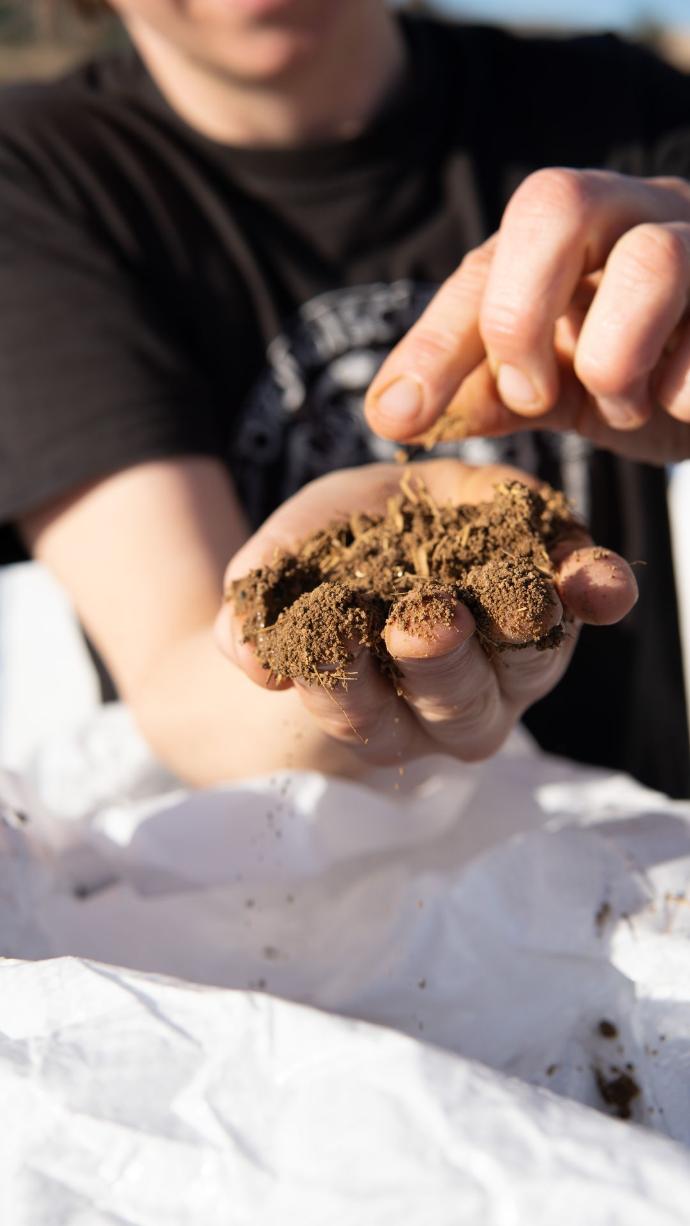
As I said, I got into it by chance and I'm very happy about it. It's just so satisfying to build with natural building materials. If I had my way, I'd only ever plaster with clay. I like the physical exhaustion and it feels natural and good. Many customers want to do the preparatory work themselves, i.e. insulating, fixing the plaster base etc. And I'm very happy to give them the opportunity to do so, but you also have to support them really intensively. I realised that very early on: good advice is worth its weight in gold! I really enjoy working with Lehm-Laden on this. David gives superb advice!
Why natural rather than conventional building materials?
My first building site was clay construction and the second was lime putty on a straw-bale house. Building with natural building materials is normal for me! I hardly know conventional building materials at all. I once cut Fermacell to size and it just feels unpleasant. You immediately get this strange dust on your skin. I am convinced by clay construction, but I don't try to convince anyone else. When someone tells me that building with natural building materials is too expensive, I always reply: if you stay in good health over the next 30 years, you also have a better chance of earning an income. The follow-up costs with natural building materials really are lower. On the one hand there are the costs to your own health, and on the other hand the costs that, with a conventional building, are passed on to society or to future generations. Clay doesn't have to be disposed of. The next generation or the one after can reuse the plaster from one wall directly on another, or simply return it to the material cycle on the compost heap.
You trained under a man. When did you first meet a female clay builder?
Yes, I trained exclusively under men. I can't remember ever meeting a female clay builder during my training. At the tradeswomen's meeting in 2011 I met other female clay builders and bricklayers for the first time. Back then there were around 40 participants, and today there are 120 women*! This year I'm part of the preparation group for the first time and have met some really great women* through it. They're mainly carpenters* and joiners*, between 20 and 40 years old.
Tell us something about the annual meeting of women in the building trades. How did it come about? Why is it so important?
The meeting, which traditionally takes place at the end of February, was founded in 1984 as a platform against the ban on women working in the construction industry, introduced by the Nazi regime in 1938 and in force in the Federal Republic of Germany until 1994. Today it is mainly about collectivity and networking. It is generally the case that women do too little professional networking and too often perceive one another as a threat or competition. The meeting serves as further training and qualifies for educational leave.
Are the founders still involved? Are the get-togethers also about an exchange between the different generations of women?
Absolutely! In my mid-thirties, I find myself somewhere between the generation of women founders and the youngest generation. The demands have of course changed a great deal over time, and I try to mediate, particularly when it comes to “gendering”. The older generation is sometimes overwhelmed by the younger one and its radical demand for gender-equitable language. It happens to me too that I accidentally use the grammatically masculine form. When someone points out in a conversation that my use of language is wrong or rather discriminatory, I do sometimes feel hurt, but then I try to change my language and actively ask how I could say something better.
Together with colleagues, you founded a regular get-together in Lüneburg. What is it about for you? Who can take part?
About a year ago we set up a regular get-together for tradeswomen. We meet on the first Friday of every month to share experiences, get to know each other and network. The get-together isn't limited to the construction industry. Any woman working in a trade can join!
In your opinion, why is it that women still make up only 13% of those working in the building trades?
Sexism! It happens to me every day that people, men in particular, don't believe I can do my job. On building sites I feel as if I'm back in the 50s. The construction industry is dominated by completely outdated gender roles, which go hand in hand with basic scepticism towards tradeswomen. Women's craft skills are constantly called into question. Sexism in the industry is so commonplace, I really don't want to gloss over it. What I notice is more the moments when my gender briefly doesn't matter and my ability isn't doubted.
How does sexism in the construction industry mainly manifest itself?
We are constantly being offered help without being asked. I'm happy to ask for help, but I don't want to be offered help all the time with my everyday routines. The so-called Load Handling Ordinance (Lastenhandhabungsverordnung) still stipulates that women should not regularly lift more than 10 kg. That's roughly the weight children reach around their first birthday. So what about the toddler, the shopping, the laundry? Care work involves very frequent lifting and, by that logic, wouldn't actually be suitable for women either. A carpenter friend of mine recently delivered a staircase she had built herself. On site, another carpenter took the staircase straight off her without asking and said to her: “Right, you can go and have a coffee now.” Unfortunately, I could tell a great many stories like that. Often it's the customers' fathers and mothers, who are helping their children build and are over 60. My 13-year-old intern was recently washing tools and one of the fathers actually said to her: “Wouldn't you rather go and wash up in the kitchen instead?”
How do the children react in a situation like that? What do you observe in young families with regard to gender roles?
My clients are often heterosexual monogamous couples. So I am confronted with traditional family structures every single day. The women do the unpaid care work, i.e. cooking, cleaning and looking after the children, while the men help out with the manual work. I have just spent a lot of time with one family. Whenever we thanked her for the daily lunch, she couldn't accept that appreciation: her work wasn't important, she said, it was us and her husband doing the hard work on the building site. She then praised her husband until nobody could remember that we had been talking about her contribution, and her mother-in-law backed her up on how wonderful her son is. That just can't be right! What she does in the background, cooking for ten people with two toddlers, I'd like to see one of the men do that. But what annoys me most is that the female clients are not allowed to make decisions and take responsibility to the same extent as their husbands. All too often they only come into play when it's time to choose the wall colour. I can't tell you how often it has happened to me that I have discussed the next work steps with a woman, we have agreed, and then suddenly a man turns up – the brother, husband, neighbour or father-in-law – claiming that what I have just advised in his absence might not be right. The women, who were already convinced, let their men unsettle them again. Why doesn't it count when a woman says another woman is doing something right? Why is that always called into question again? Why does a man always have to come along and say that it really is so? Often the women who are trapped in these male structures themselves demand that the man confirms and approves everything once more.
When and how do you voice criticism? And how do people respond to it?
The problem of sexism is often dismissed. If I'm unhappy, I have to change something to make things better for me. But I can't change the fact that my customer's father discriminates against my intern in a sexist way. I'm very often told that I chose this myself and am therefore responsible for it. No, I didn't. It bothers me. Sexism is not a personal problem but a structural one that affects us all!
What other strategies have you developed over the years?
I play a lot with appropriating and humorously reversing existing gender norms. For example, a week ago I was on a building site where three women and one man were working. When I saw him on the scaffolding in the morning, I said to him: “Oh, how lovely that men are now working on building sites too. I think that's really great. Gives us something to look at. But oops, we don't even have any men's toilets. In my company there's also the occasional token man, even though I do prefer working in FLINTA* teams.” I also like walking across the site and calling out: “I'm looking for four hard-working men or one strong woman to give me a hand for a moment.”
You prefer working on women* or FLINTA* building sites. Why? What is different when only FLINTA* people work together? And what does FLINTA* actually mean?
FLINTA* stands for F rauen (women), l esbian, i ntersex, n on-binary, t rans and a gender people, in other words everyone who faces patriarchal discrimination because of their gender identity. On the one hand, I have noticed that when I work with FLINTA* people, I can respond to sexist actions and remarks more confidently and more quickly. Together we are much better at recognising and calling out sexism. On the other hand, I have simply had so many good experiences working with women. Women, and mothers in particular, are very good at organising and structuring their tasks. They can often work fewer hours than men, but in that short working time they quite often achieve more than a man working full-time.
What would you like to see in terms of greater gender equality in the construction industry?
In general, we need more visibility for women and recognition of what they achieve. Women have to achieve far more to get the same recognition as a man. That has to change! Women and girls should be addressed explicitly so that they find their way into the trades. We need more women in leadership positions – and not just the top of the class with distinctions! We also urgently need maternity protection for women who start their own businesses. For tradeswomen in particular who run their own business, a pregnancy is a financial disaster.
Tell us a bit about your current building sites. What are you working on at the moment?
There
is a timber-frame renovation in a listed half-timbered house
near Dahlenburg. The timber frame has already been restored by
carpenters and bricklayers. First we levelled the entire layer with
clay plaster, and now a 6 cm thick Wood fibre board
for internal insulation. The installation is carried out by clay builders or
carpenters who work for me. The board is cut to size with a
circular saw and then, using an impact drill and Clay adhesive mortar fixed to the wall. At the end comes the Clay plaster on it.
The outer shell is being sealed up, so insulated and rendered. And then
there's a whole load of old historic ceilings, where the customers are now
taking the surfaces off, so loads of old paint. When the
plaster comes off, I repair it properly. There's also
timber framing on the interior walls, some of which is being Thatching reed
stapled and plastered. I also bought the reed from the Lehm-Laden.
But there are also half-timbered walls that are meant to remain visible. There,
only the infill panels are plastered with clay. Finally, there are also a few
sloping ceilings where Clay building boards get done.
We are actually starting work as early as November, but that's only possible because underfloor heating is already installed and we can maintain the temperature needed for drying. It's still relatively new for us to work in winter. Winters are getting warmer and warmer, so you can control the drying well. I still find it challenging; customers need to be well informed that a winter building site comes with high energy costs. At the moment, they probably need to budget an extra 1000 - 2000 € if they want to plaster between December and February. The additional costs come from construction dehumidifiers, fan heaters, lots of lighting and the heating costs in the as yet uninsulated house. The electricity consumption for drying the clay alone costs approx. 80€ per day.
What is your relationship with Lehm-Laden? How long have you known David? How did you meet? Can you tell us something about the history of your friendship?
When we met 11 years ago, we were both just starting our families. Whenever I was able to work, I worked with David. David had larger construction sites where I could come in as a subcontractor under an itinerant trade licence. He always used to say to me: “Anna, I want to open an online shop. I want to sell these materials and offer building-biology consultancy.” Together we worked out who we want to be: retailer and applicator. Over the years, a valuable business friendship has developed. I'm glad that we have grown together, and our children have too. This year I can finally come along to the Fachmesse Lehmbau trade fair. David has asked me every year, and it was just never possible because of a lack of childcare. David is one of the few men in the industry who has always recognised me directly, regardless of my gender identity.
Besides, he simply knows the subject really well. Sometimes I get advice from him myself and then pass the knowledge on to my clients, or I send them straight to Lehm-Laden. Recently that has no longer been necessary at all. Clients now get information from Lehm-Laden in advance. When we then arrive on site, they already know what they will be doing themselves, which clay building board and substructure they will use, and how they need to prepare the walls, so that all we have to do is plaster. They also already know which plaster and how thick. All the preliminary advice has already taken place. I think that's exactly how David and I always wanted it. This good cooperation makes my work so much easier. I no longer have to explain how to prepare a wall: scraping off old paint, applying primer, fixing the plaster base, etc. These are the kinds of work steps that David and his team have advised on so well over the phone that construction sites are now much better prepared. The furniture is out, the protective coverings have been bought from Lehm-Laden and laid out. That's really nice. We can also take on smaller jobs again because people are so well prepared.
Customers get a great deal of attention at the Lehm-Laden! Women are advised just like men, without prejudice. Sadly, that isn't normal in the construction industry. Women are usually told, well, you can't do that anyway. It has happened to me that I'm standing in a conventional DIY store in my work gear and a member of staff, unasked, wants to explain a screw to me! Something like that would be unthinkable at the Lehm-Laden. There, everyone experiences that they can do it themselves and can trust themselves to do it!
What did you buy today, and what for?
I bought lime bonding plaster and clay adhesive and reinforcing mortar.
The Lime bonding plaster
we will apply to the insulation boards in the bathroom area. The mesh will
then be embedded in it. This gives us a stable, sound and load-bearing
base for the lime finishing plaster. I will order this with the next
delivery. The Clay adhesive and reinforcing mortar
we use for bonding the insulation boards and for the mesh layer on
the insulation boards. We use the lime in the wet rooms,
Do you have a favourite product in the Lehm-Laden?
Definitely the Conluto terra fein!
Dear Anna, thank you for your time!