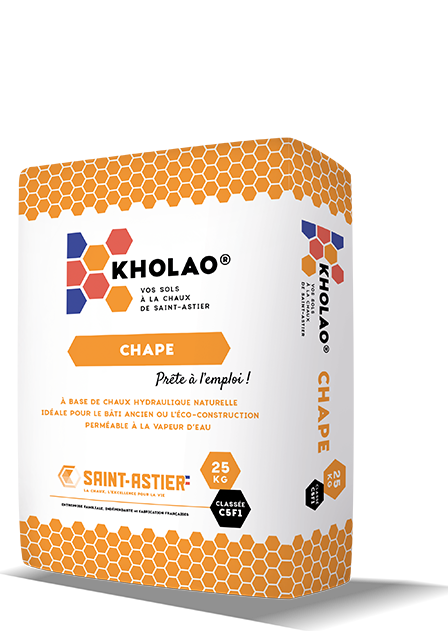
KHOLAO® Chape - Lime Screed
Ready-mixed lime screed. Vapour-permeable (diffusion-open) screed without cement. For use in historical buildings and constructions using natural building materials. Pumpable with screed pumps!
50 bags / pallet (1250 kg)
Layer thickness 3 to 10 cm
6 bags / m² at 8 cm layer thickness
KHOLAO® CHAPE – Lime-based screed mortar for interior use
With KHOLAO® CHAPE, you get a factory-mixed, lime-based screed mortar based on natural hydraulic lime from Saint-Astier®. The mortar is designed for indoor screed structures, especially if you are using mineral or natural substrates or prefer a cement-free system.
The screed is vapour-permeable and capillary-active – properties that can be particularly important in renovations, but also in new buildings.
Advantages over conventional screeds
- diffusion-open and capillary-active: Lime screeds can absorb and release moisture. This supports natural moisture exchange in the soil structure.
- Reduced material stresses: The curing process is slower and generates less tension than with cement-bound screeds. This can be advantageous in existing buildings and with natural substrates.
- Cement-free: The screed does not require cement or polymer-based additives.
- Low-emission raw material base: The production of natural hydraulic lime requires lower firing temperatures than cement, which significantly reduces CO₂ emissions. KHOLAO® is low in emissions and has been awarded the ‘Excell Vert’ label.
- Compatibel with natural and existing materials: Lime screeds can be used on substrates such as lime, clay or hemp-lime concrete, provided that the substrate test shows sufficient load-bearing capacity.
- Easy to repair: Lime screeds are often easier to partially repair or remove than cement-bound screeds.
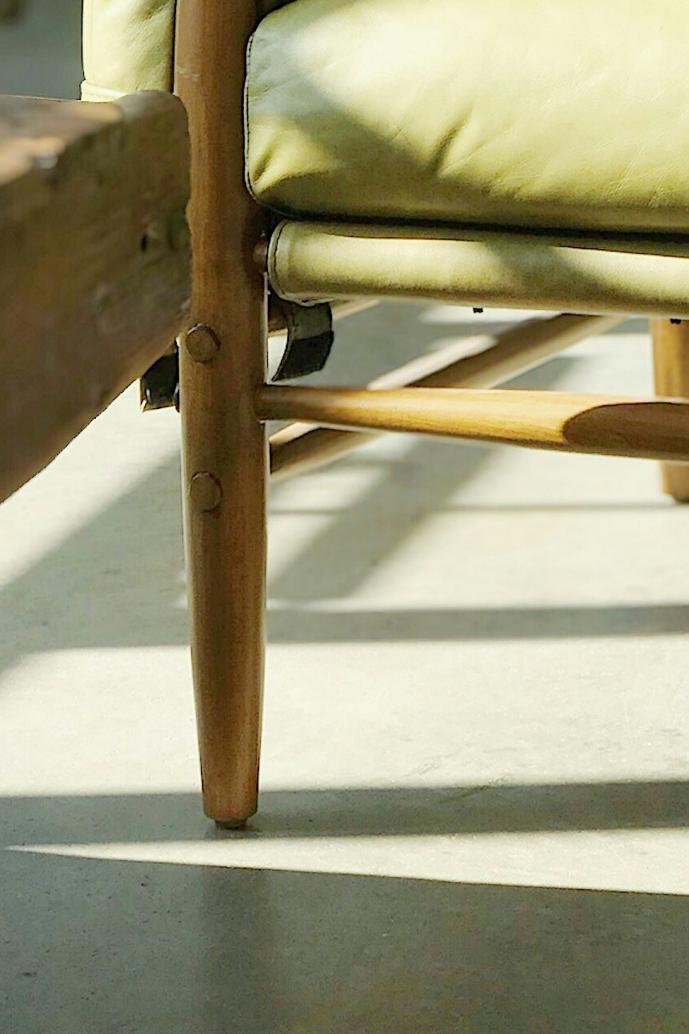
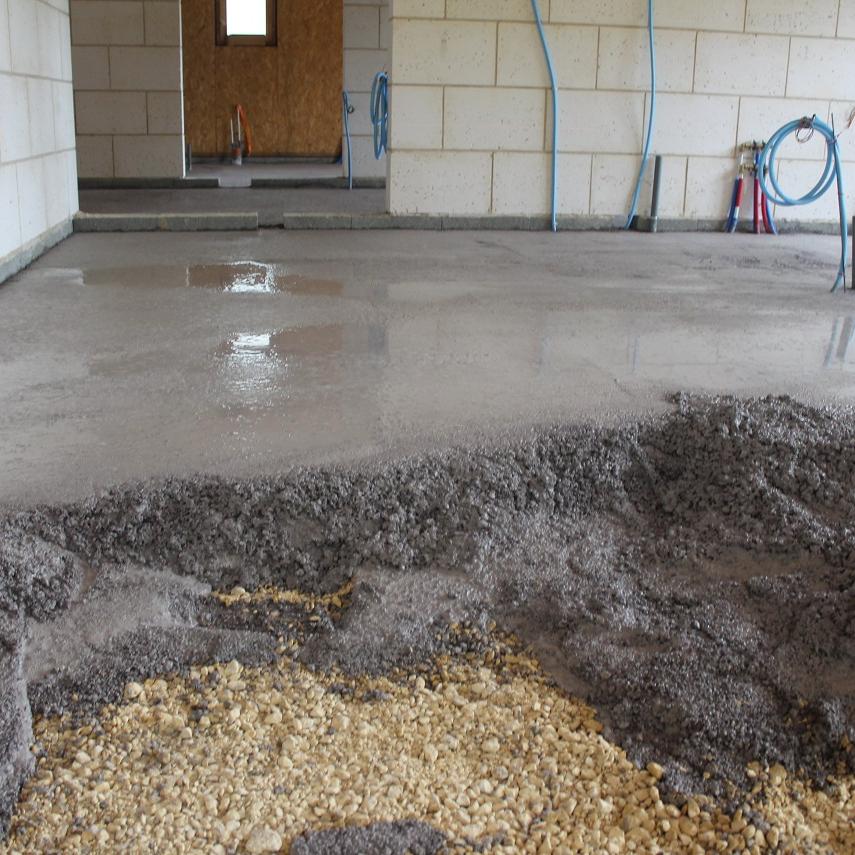
Application
KHOLAO® CHAPE is used as screed for indoor areas. Before installation, check the substrate for load-bearing capacity, moisture and evenness.
Possible substrates
- Lime concrete and other mineral substrates
- Natural and clay building materials (after substrate testing))
- Foam glass gravel
Processing
Mix with clean water (concrete mixer or compulsory mixer). Apply in the specified layer thickness. Smooth the surface. Protect from draughts and direct sunlight. Select coverings that meet the respective requirements.
If you have any questions about the right floor structure, we will be happy to assist you.
Frequently asked questions about KHOLAO Chape
How is KHOLAO Chape mixed?
Add 2–3 litres of water per 25 kg bag in a forced-action or concrete mixer. The mortar should be earth-moist like wet sand: squeezed in the hand it keeps its shape. Workable between 5 and 30 °C, open time about 3 hours.
How thick is KHOLAO Chape laid?
According to the manufacturer 3–10 cm. Bonded to load-bearing concrete at least 40 mm, floating 60–80 mm. On timber joist floors only floating at 60–80 mm and after checking the structural capacity.
How is the substrate prepared?
The substrate must be load-bearing, clean and dust-free and must be dampened before laying. On smooth or dense concrete use a bonding bridge: SBR latex (for example SIKA Latex) at 10 % of the mixing water. Place an edge strip of cork, XPS or similar material all around.
Can I work in two layers?
Yes, always wet on wet: the second layer no later than 48 hours after the first, with the thicker layer at the bottom. If more time has passed, a bonding bridge is needed (SIKA Latex, 10 % of the mixing water of the second layer).
Can lime screed be used with underfloor heating?
Yes, Saint-Astier has confirmed this for low-temperature underfloor heating. The cover above the top of the pipes is at least 50 mm for KHOLAO Chape and at least 60 mm for self-mixed screed. First heat-up no earlier than after 4 weeks: start at 20–25 °C, increase in steps of 5 °C, maximum flow temperature 45 °C.
Does lime screed need joints?
Yes, because lime screed shrinks as it sets. Place field joints roughly every 25 m² and align them with the joints of the concrete slab below. Perimeter joints run along all walls, columns and door openings (edge insulation strip 8–10 mm) and always remain open – the skirting board covers them. With a floor covering, each field joint is continued in the covering at the same position. Only with exposed screed are the field joints closed with cork filler after at least 28 days.
When can I lay a covering or tiles?
KHOLAO Chape can take light foot traffic after about 3 days. Lay natural stone and terracotta with KHOLAO Colle no earlier than after 7 days. For other coverings: pH below 10, residual moisture CM ≤ 2 %, with underfloor heating CM ≤ 1,5 %.
Can lime screed be left exposed?
Yes, protected with stone oil. However, exposed screed is only intended for "sock areas" – living spaces where people walk barefoot or in socks. Lime screed has a lower strength than cement screed (KHOLAO Chape: class C5F1 to EN 13813). For more heavily used areas we recommend a covering of natural stone or terracotta.
Is lime screed vapour-open?
Saint-Astier does not state its own measured value for KHOLAO Chape; the manufacturer describes it as vapour permeable. Comparable lime mortars made of NHL 5 and sand achieve a water vapour diffusion resistance factor of µ < 8 according to manufacturer data (measured to EN 1015-19). For a screed thickness of 40–60 mm this gives a calculated sd value below 0,5 m – under DIN 4108-3 such a layer is considered vapour-open.
Handelsmarke Adresse
Chaux & Enduits de Saint-Astier®28, bis route de Montanceix, 24110 Saint-Astier, Frankreich
+33 5 53 54 11 25
Contact_export@saint-astier.com