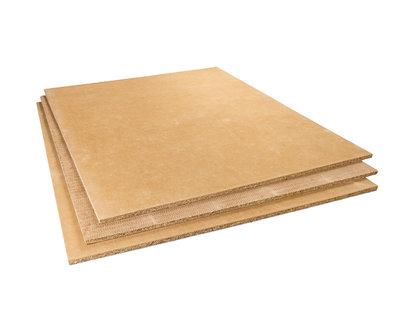
Clay drywall elements
The Conluto company is not only committed to the production of the most natural building material, but also to its further development. For this reason, clay dry construction is also served with an innovative clay building board that combines all the room-climatic properties of our favourite material, clay:
-
Natural
-
Best sound insulation properties (52 dB)
-
Diffusion-open and thus moisture-regulating
-
Non-flammable, class A1
-
Material properties

The clay building board is used in dry construction as a partition wall, planking and cladding, in roof finishing and as a ceiling element. It measures 125 x 62.5 cm, is available in 16 and 22 mm thickness, is easy to handle and process and guarantees time-saving work. It can be used in new buildings as well as in the renovation of historical buildings.
The clay board impresses with its high dimensional accuracy, is firm and dimensionally stable. The Conluto clay building board is made of different types of clay, untreated wood fibres and plant starch and is reinforced on one side with jute fabric. Direct processing at the site of clay extraction saves primary energy and CO². The boards are mechanically pressed and dried with residual heat from production. It doesn't get much better than this.
Substrates for clay boards

Timber stud walls
Clay building boards with a thickness of 22 mm can be easily and rationally applied to an interior wall that has been appropriately gridded with wooden studs, as well as in roof slopes and ceilings. Metal profiles are also suitable for fastening, provided there is additional transverse stiffening. The centre distance of the substructure should be 31.25 cm or 62.5 cm for the clay building boards. If studs or rafters are present, the load-bearing battens are dimensioned accordingly. The load due to the additional application of the plaster must be taken into account. The 16 mm clay building board always needs a full-surface wooden substrate, such as formwork made of rough sheet piling.
Masonry walls
The clay building board is also ideally suited for application on flat substrates such as concrete, sand-lime brick and brick walls and wood-based panels. Here, it can usually even be simply glued on. Both the 16 and 22 mm boards can be used on partition and interior walls, and the 16 mm board can be used on ceilings and in sloping roofs..
The clay building board can also be used on old plaster substrates: This way, damaged, uneven walls get a straight surface again. Larger defects must be repaired with clay base plaster and sufficiently dried before installation. By the way, clay building boards can also do a wonderful job as a moisture regulator in bathrooms (outside of wet areas), thus preventing mould infestation.


Installing clay building boards
Clay boards are very easy to install on the prepared substrate. Various types of fastening are available for this purpose: Corrosion-resistant screws and wide back staples on wooden substructures, on flat substrates the panel can be glued. The panels can also be fastened to a wooden substructure (grid or full-surface) with a pneumatic tacker and suitable wide-back staples . This is particularly quick and efficient. On sloping roofs it is absolutely necessary to additionally screw the panel. Here, the board can be fastened quickly with the stapler, then secured with the screws.
Retaining plates for the clay boards Matching screws
The panels are now fixed with screws and retaining plates or staples. On flat, load-bearing, vertical walls, the boards can be easily glued with clay adhesive and reinforcement mortar. The joints of the edges must be fixed with an offset of at least 25 cm. At door and window reveals, make sure that the board is cut out in an L-shape at the corners. At the panel joints, the screws are either placed with a 2 cm edge distance or screwed into the joint using a retaining plate (not on ceilings and roof slopes).
Heating, gas and water pipes can be accommodated as usual in dry construction. Socket openings are also sawn out as usual with the hole saw. If only pictures, lamps and other light objects are to hang on the walls, fastening with screws and dowels is sufficient. For radiators, wall cabinets and similar heavy objects, the substructure must be equipped with correspondingly strong wooden slats.


Mounting the clay boards
Once installed, clay building boards can be worked on straight away.
The boards are lightly moistened with a sprayer and skimmed with adhesive and reinforcing mortar. A reinforcing mesh is embedded across the entire surface of the applied plaster.
Once the wall is completely dry, it can be plastered with clay fine plaster in a thickness of 2 - 3 mm. It is possible to apply a facing plaster or finishing plaster . Here you can decide according to your own surface requirements. If the substrate is made of OSB boards, make sure that the plaster is applied as thinly as possible on the board. A lot of moisture due to thick plaster layers can deform the boards, as the moisture cannot be released to the substrate, and can thus lead to tensions in the board.
After the plaster has dried to a leather-hard consistency, it can be sponged, rubbed or smoothed.
Clay paint or clay brushed plaster can now be painted onto the clay fine coat plaster as well as the clay fine-finish plaster.
All of the above-mentioned surface products support the outstanding room-climatic properties of clay building board and clay plaster.

Lightweight hemp-clay building board
Lightweight, fibre-reinforced hemp-clay board made of clay building material for sheathing (type A) and lining of walls, ceilings and sloping ceilings in accordance with DIN 18948. System for installation area DIN 4103-1.
- used for constructing partition walls, for sheathing timber frame or timber stud constructions and for lining existing plastered surfaces
- store flat on a pallet; protect boards from moisture and store in a dry place; cover with a tarpaulin / sheeting
- Protect the boards from moisture and store them in a dry place
- fastening is done with screws, staples or adhesive
- dry loose-fill material
- suitable for universal use